Image








According to the World Economic Forum's "Future of Jobs Report 2020", data-related professions are at the top of the list of professions that are set to evolve the most over the coming years. Big data analysis is also among the 5 fastest-growing skills since the pandemic crisis, according to a November 2020 LinkedIn study.
Based on a pedagogical approach combining multidisciplinary teaching, projects and feedback, the MSc Data Engineering & Cloud Computing is designed to respond to the opportunities and challenges raised by the massification of data in all sectors of economic activity and all areas of modern society, leading to a major transformation of professions and practices.
Faced with exponential growth in data volumes, companies of all sizes and in all sectors now have no choice but to think about and implement solutions capable of addressing the issues linked to this megadata, described as "fuel" or "black gold" because its value feeds the digital economy. Moreover, the importance of data is not confined to the business world. Public organizations, scientific research, NGOs, local authorities and Smart Cities are also concerned.

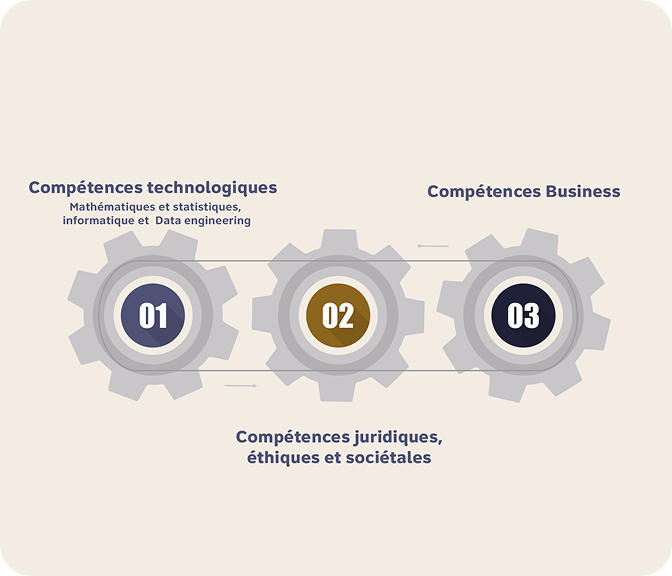
The program is both technical (Cloud Computing, Programming, Database Management) and theoretical (Distributed Algorithms, Machine Learning, Distributed Database Theory). This dual approach means you'll be able to use the most common and effective tools while understanding the fundamentals of their mechanisms, so you can use them under the best conditions and configure them quickly. What's more, learning about different tools and their principles enables students to learn how to adapt to different technologies and quickly become efficient on any such tool.
The first year consolidates mastery of a data-driven project. An MSc DE1 student will be able to set up a project and propose robust architecture for projects handling reasonable volumes of data (use of centralized databases). Some high-volume computing techniques are presented.
The second year specializes in the processing of massive data (known as Big Data). From storage to analysis, this year trains students to become experts in the management of massive data projects. Different types of Clouds are presented (AWS and Azure), as well as NoSQL databases.
The program introduces many of the technologies regularly used in business, and a scientific and technological watch enables us to present cutting-edge tools and approaches in order to get to grips with them. In order to train experts in Data Engineering and Cloud Computing, the course also focuses on the place of these skills in society, through a business approach coupled with the ethics of data manipulation, green computing and the laws governing this field.