Articles

Why is everyone talking about agents?

By Dr. Burak ÇIVITCIOĞLU Associate Professor at aivancity in Artificial Intelligence, Machine Learning & Deep Learning 

Since the start of the AI revolution — let’s call that the release of ChatGPT-3 — the capabilities of large language models (LLMs) have been accelerating rapidly.

Let’s put this into perspective :

Just a few months ago, Veo 3 didn’t exist — and now, it’s setting new benchmarks in video generation.
A little further back, we were just beginning to see improved reasoning with Claude Sonnet 3.5 and GPT-4o.
Today, GPT-4o is the baseline. We use it for quick responses, not necessarily deep reasoning.

Since December 2024, we’ve entered what is now called the era of reasoning models. It began with o1, which has already been replaced. Now, we have access to o3, OpenAI’s most advanced reasoning model — as of today.

And yet, somehow, it already feels like these tools have always been with us. It’s hard to believe ChatGPT launched just 2.5 years ago.

It’s not enough to talk about smarter models without talking about how cheaper they’ve become. Let’s get specific.

LLM pricing is typically measured in price per one million tokens.
A token is basically a chunk of a word.
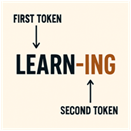
  • “Learning,” for example, contains about 2 tokens.
  • A standard A4 page has around 600 tokens.
  • A typical novel? Roughly 100,000 tokens.
  • So, 10 novels is around 1 million tokens.

Now let us pause for a second. Can you guess what 1 million tokens might cost today, and what they cost when ChatGPT was first released?

Here’s the reality :

  • In 2020, GPT-3’s beta launch came in at $50 per million tokens.
  • Today, GPT-o3 — the most advanced model available — is just $2 per million tokens.
  • And GPT-4.1-nano, a faster and cheaper model, comes in at just $0.10 per million tokensthat’s 500x cheaper than the original GPT-3.

Worth noting: the cheapest model today is still more capable than GPT-3 in 2020.
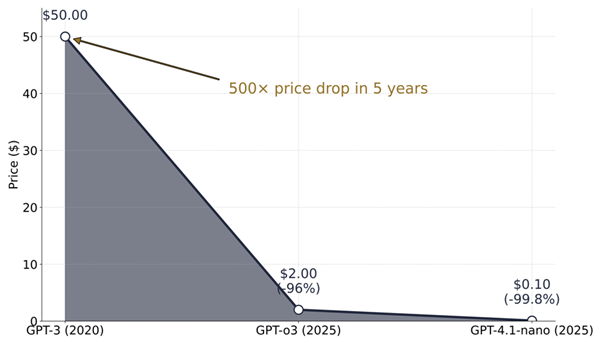
This massive price drop changed everything. It unlocked access for researchers, developers, and hobbyists. Some models, like Mistral, are free for educational or personal use under the right conditions.

But how does this relate to AI Agents ?

OpenAI defines it simply:

“Agents are systems that independently accomplish tasks on your behalf”

Here’s how that works in practice :

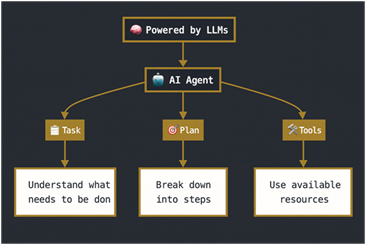
  1. Task: The agent receives a natural language task.
  2. Plan: It breaks that task down into subtasks using LLMs.
  3. Tools: It executes the plan using tools — like browsing the web, running a script, or querying a database.

Let’s say you ask an agent to “find information about Aivancity School of AI and Data for Business and Society, its ranking and educational quality.”
Here’s what happens:

  • The agent interprets the request.
  • It builds a plan, maybe starting with search queries, followed by summarizing articles, then fact-checking.
  • It uses tools like a browser to execute.
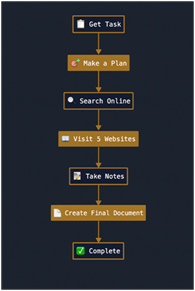
As a result, the agent will find that aivancity is 1st in France according to Eduniversal rankings of schools of AI and Data Science.

So you can think of an AI agent as having three main pillars:

  • A task to complete
  • A plan to follow
  • A set of tools to use

Behind the scenes, all of this is made possible by LLMs: understanding what you say, deciding what to do, and executing with awareness of tool limitations and capabilities.

AI Agents have existed as a concept for a while. What’s changed is the economics, and the rapid performance increase of LLMs.

Thanks to lower costs and better models, we are no longer just generating text. We’re generating outcomes.

That means we can get slides from a lecture video, organized notes from raw transcripts, booking flights, summarizing emails by urgency or importance; all using AI Agents.

In other words, LLMs are now becoming doers.

And that is why everyone is talking about Agentic AI.

Don't miss our upcoming articles!

Get the latest articles written by aivancity experts and professors delivered straight to your inbox.

We don't send spam! Please see our privacy policy for more information.

Don't miss our upcoming articles!

Get the latest articles written by aivancity experts and professors delivered straight to your inbox.

We don't send spam! Please see our privacy policy for more information.

Related posts
Articles

War in the Age of AI

When algorithms enter the fray

By Dr. Tawhid CHTIOUI, Founding President of aivancity School of AI & Data for Business & Society; selected by Keyrus as one of the 25 most influential global figures in the field of AI and data…
Articles

When AI Reaches the Level of Average Human Creativity: Schools and the Workplace Confront the End of a Comforting Myth

By Dr. Tawhid CHTIOUI, Founding President of aivancity, the leading school for AI and data A student submits a brilliant paper. The ideas flow smoothly, are well-structured, and are original without being confusing. The reasoning is coherent,…
Articles

2026: The surge in free AI courses from Microsoft, Google, Stanford, and MIT. Can we learn AI without learning about the world it is transforming?

By Dr. Tawhid CHTIOUI, Founding President of aivancity, the Leading School of AI and Data 1. The Comforting Illusion of Technical Training By the end of 2025, a strange consensus had taken hold. Faced with the sudden emergence…
The AI Clinic

Would you like to submit a project to the AI Clinic and work with our students?

Leave a comment

Your email address will not be published. Required fields are marked with *

Articles

Why is everyone talking about agents?

By Dr. Burak ÇIVITCIOĞLU Associate Professor at aivancity in Artificial Intelligence, Machine Learning & Deep Learning

Since the start of the AI revolution – let’s call that the release of ChatGPT-3 – the capabilities of large language models (LLMs) have been accelerating rapidly.

Let’s put this into perspective :

Just a few months ago, Veo 3 didn’t exist – and now, it’s setting new benchmarks in video generation.
A little further back, we were just beginning to see improved reasoning with Claude Sonnet 3.5 and GPT-4o.
Today, GPT-4o is the baseline. We use it for quick responses, not necessarily deep reasoning.

Since December 2024, we’ve entered what is now called the era of reasoning models. It began with o1, which has already been replaced. Now, we have access to o3, OpenAI’s most advanced reasoning model – as of today.

And yet, somehow, it already feels like these tools have always been with us. It’s hard to believe ChatGPT launched just 2.5 years ago.

It’s not enough to talk about smarter models without talking about how cheaper they’ve become. Let’s get specific.

LLM pricing is typically measured in price per one million tokens.
A token is basically a chunk of a word.

  • « Learning, » for example, contains about 2 tokens.
  • A standard A4 page has around 600 tokens.
  • A typical novel? Roughly 100,000 tokens.
  • So, 10 novels is around 1 million tokens.

Now let us pause for a second. Can you guess what 1 million tokens might cost today, and what they cost when ChatGPT was first released?

Here’s the reality:

  • In 2020, GPT-3’s beta launch came in at $50 per million tokens.
  • Today, GPT-o3 – the most advanced model available – is just $2 per million tokens.
  • And GPT-4.1-nano, a faster and cheaper model, comes in at just $0.10 per million tokensthat’s 500x cheaper than the original GPT-3.

Worth noting: the cheapest model today is still more capable than GPT-3 in 2020.

This massive price drop changed everything. It unlocked access for researchers, developers, and hobbyists. Some models, like Mistral, are free for educational or personal use under the right conditions.

But how does this relate to AI Agents?

OpenAI defines it simply:

« Agents are systems that independently accomplish tasks on your behalf ».

Here’s how that works in practice :

  1. Task: The agent receives a natural language task.
  2. Plan: It breaks that task down into subtasks using LLMs.
  3. Tools: It executes the plan using tools – like browsing the web, running a script, or querying a database.

Let’s say you ask an agent to « find information about Aivancity School of AI and Data for Business and Society, its ranking and educational quality. »
Here’s what happens:

  • The agent interprets the request.
  • It builds a plan, maybe starting with search queries, followed by summarizing articles, then fact-checking.
  • It uses tools like a browser to execute.

As a result, the agent will find that aivancity is1st in France according to Eduniversal rankings of schools of AI and Data Science.

So you can think of an AI agent as having three main pillars:

  • A task to complete
  • A plan to follow
  • A set of tools to use

Behind the scenes, all of this is made possible by LLMs: understanding what you say, deciding what to do, and executing with awareness of tool limitations and capabilities.

AI Agents have existed as a concept for a while. What’s changed is the economics, and the rapid performance increase of LLMs.

Thanks to lower costs and better models, we are no longer just generating text. We’re generating outcomes.

That means we can get slides from a lecture video, organized notes from raw transcripts, booking flights, summarizing emails by urgency or importance; all using AI Agents.

In other words, LLMs are now becoming doers.

And that is why everyone is talking about Agentic AI.

Related posts
Articles

Less certainty, more awareness: AI shows the way that schools dare not take

Just imagine. You ask a question to a state-of-the-art artificial intelligence, loaded with artificial neurons, gorged with planetary data, more connected than your teenager on a Saturday night, and it answers you, without blushing: « I don’t know. »
Articles

7 ethical principles for trustworthy artificial intelligence

By Pr Nathalie DEVILLIER Doctor of International Law | Professor of AI Law and Ethics at aivancity To achieve trustworthy AI, seven fundamental ethical principles must be applied and evaluated throughout the lifecycle of the…
Articles

Europe, Wake Up ! Your AI Skills Gap Could Cost You Your Sovereignty

March 2025. In the hushed atmosphere of a London conference center, a hundred European leaders, including government officials, business executives, union representatives and digital experts, scrutinize the slides of a freshly released report by the consultancy Forrester.
The AI Clinic

Would you like to submit a project to the AI Clinic and work with our students?

Leave a comment

Your email address will not be published. Required fields are marked with *