
Food allergies are now a major public health issue, and their prevalence continues to grow worldwide. According to international health organizations, more than 250 million people worldwide live with a food allergy, a figure that is steadily rising1. In Europe, prevalence has risen by about 50% over the past fifteen years, while a severe allergic reaction leads to a hospitalization every 10 seconds in industrialized countries2. In response to this reality, a French startup presented a groundbreaking technological innovation at CES in Las Vegas: a portable detector capable of quickly identifying the presence of food allergens directly in the dishes being consumed.
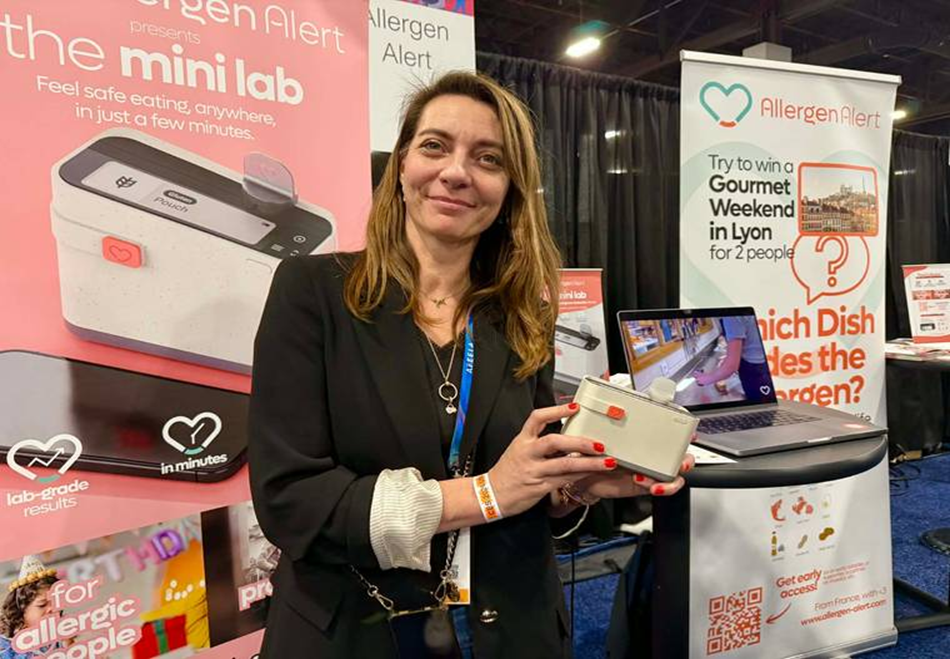
A portable mini-lab for food analysis
The device stands out for its technological approach. It relies neither on a simple self-reported analysis nor on automated label scanning, but on a true miniaturized biological analysis system. The device incorporates a mechanism capable of replicating, on a small scale, the main steps of a laboratory test: sample preparation, protein extraction, and targeted detection. The user takes a tiny sample of the food, inserts it into a single-use cartridge, and then starts the analysis. In just a few minutes—compared to several hours in a traditional laboratory—the system provides a result indicating the presence or absence of targeted allergens, with a level of accuracy comparable to that of in vitro diagnostic tests3.
Identify the allergens responsible for the majority of reactions
The technology focuses on the food allergens most commonly associated with severe reactions. The device is designed to detect nine major allergens, including peanuts, wheat, milk, eggs, tree nuts, soy, fish, shellfish, and sesame, as well as gluten for people with celiac disease. These substances account for approximately 80% of severe food allergic reactions reported in Europe and North America4. This targeted approach combines rapid analysis with clinical relevance by focusing on the most critical risks.
Making everyday risky situations safer
One of the key advantages of this detector is its portability. It can be used in situations where people with allergies are particularly at risk, such as restaurants, while traveling, at meals with family and friends, or at group events. According to health authorities, nearly half of all severe allergic reactions occur outside the home, often as a result of cross-contamination that is difficult to anticipate5. By allowing for direct verification before consumption, the tool provides an additional layer of safety and helps empower people with allergies in their daily lives.
An innovation born from personal experience
The project originated from a profound personal experience. The startup’s founder witnessed a severe allergic reaction within her family, which highlighted the limitations of existing measures to prevent such risks. This situation served as the starting point for designing a tool intended as a complementary safeguard, usable at any time and in any environment. This approach, centered on real-world use, guided the development of a technology aimed at combining scientific reliability, ease of use, and speed of execution.
Growing interest beyond the general public
While the program is primarily aimed at individuals, its potential extends far beyond this scope. Food allergies also affect institutional catering—including school and hospital meal services—where they pose a major liability risk. In France, more than 7 million meals are served daily through institutional catering, automatically increasing the risk of exposure to allergens6. The technology is thus attracting interest from food service professionals and institutional stakeholders seeking to strengthen their prevention measures. In the longer term, this analysis platform could be expanded to other areas, such as the detection of environmental contaminants or water quality analysis.
Ethical Issues and Limitations of a Portable Allergen Detector
Despite its promise, this type of device raises several ethical and operational questions. The reliability of the results is a key concern, particularly given the risk of false negatives. A false positive could expose the user to a serious, even life-threatening, reaction, which necessitates rigorous clinical validation and quality control.
The issue of liability also remains a key factor. In the event of an incident, determining the division of liability among the manufacturer, the user, and, where applicable, the food service professional remains complex. Finally, health authorities remind the public that these tools are not a substitute for a medical diagnosis or the recommendations of healthcare professionals. They should be viewed as decision-support tools that complement, rather than replace, existing prevention strategies7.
Toward the Democratization of Food Analysis
The startup behind this detector recently raised over 3 million euros to finalize the development of its solution and prepare for mass production. The business model is based on an affordable device and cost-effective consumables, with individual tests priced at less than 10 euros. This strategy aims to make food analysis suitable for regular use and to transform a technology historically reserved for specialized laboratories into an everyday tool, promoting safer and more inclusive food.
Learn more
This breakthrough underscores the growing role of artificial intelligence in the early detection and detailed analysis of biological signals. On a related topic, read our article “AI Identifies a Biomarker of Chronic Stress for the First Time Using Medical Imaging”, which shows how AI models help us better understand mechanisms invisible to the human eye and open up new possibilities in prevention and public health.
References
1. World Allergy Organization. (2023). The global rise of food allergies.
https://www.worldallergy.org
2. European Academy of Allergy and Clinical Immunology. (2022). Prevalence of food allergies in Europe. https://www.eaaci.org
3. bioMérieux. (2024). Advances in in vitro diagnostic technologies.
https://www.biomerieux.com
4. European Food Safety Authority. (2022). Food allergens and public health.
https://www.efsa.europa.eu
5. ANSES. (2023). Food allergies and associated risks.
https://www.anses.fr
6. Ministry of Agriculture. (2023). Institutional Food Service and Food Safety.
https://agriculture.gouv.fr /a>
7. Haute Autorité de Santé. (2023). Food allergies: prevention and management.
https://www.has-sante.fr
