


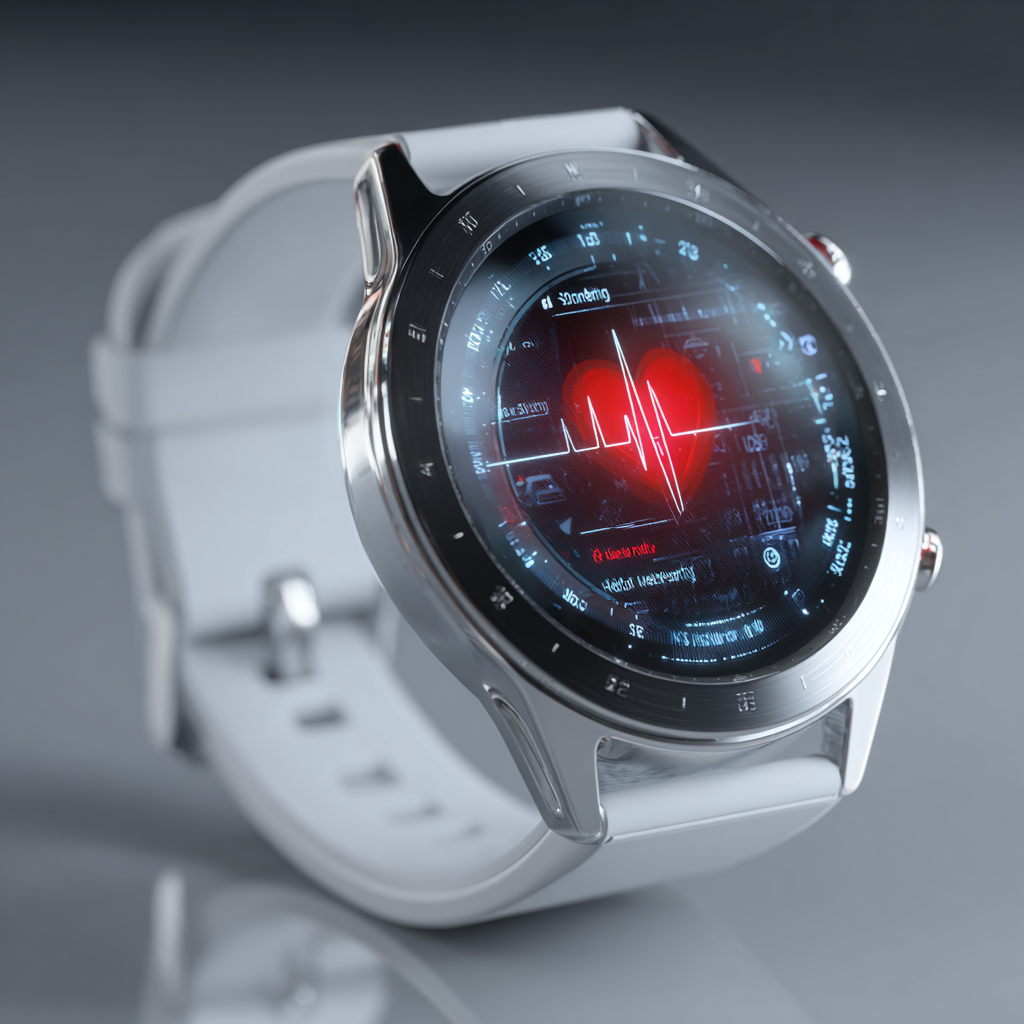
Smartwatches are establishing themselves as true next-generation medical devices. With its Galaxy Watch, Samsung has reached a new milestone: integrating artificial intelligence capable of detecting early signs of heart failure, a chronic and silent condition that affects more than 64 million people worldwide, according to the World Health Organization1.
This innovation reflects a major trend: the convergence of wearable technology, predictive analytics, and preventive healthcare. Whereas smartwatches were previously limited to tracking heart rate or sleep, they are now becoming tools for proactive medical alerts, capable of identifying subtle signs even before symptoms appear.
Artificial intelligence is becoming central to cardiac diagnosis
The system developed by Samsung relies on AI built into the Galaxy Watch, which is capable of continuously analyzing the user’s physiological data: heart rate, heart rate variability, oxygen saturation, sleep quality, and stress levels. Once aggregated, these signals are processed by a predictive model trained on millions of anonymized biometric records from clinical studies and partner hospital databases.
The goal is to identify the characteristic patterns of early-stage heart failure, which are often invisible to the human eye. For example, a slight irregularity in the nighttime heart rhythm, combined with a drop in blood oxygen saturation, can trigger an alert from the model several days before the onset of shortness of breath or edema.
According to initial results published by Samsung Research, this AI reportedly achieved an accuracy rate of over 85% in identifying high-risk patients during internal clinical trials2.
An innovation that is transforming the way medical care is managed
This technology is part of a broader trend: predictive medicine, in which artificial intelligence aids in diagnosis prior to clinical examination.
- For patients, it offers an opportunity to anticipate complications and avoid emergency hospitalizations.
- For doctors, it paves the way for remote monitoring enhanced by continuous, context-specific metrics.
- For healthcare systems, it can reduce costs associated with chronic diseases, with heart failure alone accounting for 2 to 3% of global hospital spending3.
If an abnormality is detected, the watch does not provide a medical diagnosis, but encourages the user to consult a healthcare professional. In this case, the AI acts as a vigilance monitor, not as a substitute for a cardiologist.
Health Technology Through the Lens of Responsibility
The integration of artificial intelligence into consumer devices raises significant questions regarding reliability, privacy, and medical liability.
- Reliability: The accuracy of the algorithm depends on the quality of the collected data, which may vary depending on the sensor’s placement or calibration.
- Privacy: Cardiac data is among the most sensitive information in the medical field; it must be encrypted, anonymized, and stored locally before any processing takes place.
- Liability: If AI fails to detect a warning sign, who is liable: the manufacturer, the model developer, or the healthcare professional?
Samsung states that the Galaxy Watch complies with the requirements of the European Medical Device Regulation (MDR) and the GDPR by storing medical data on the device rather than in the cloud.
Artificial Intelligence as a Prevention Tool
This breakthrough is part of a global trend toward innovation in digital health. Companies such as Apple, Fitbit, and Huawei are also exploring AI models capable of detecting cardiac, respiratory, or neurological abnormalities.
But Samsung stands out for its preventive—rather than merely reactive—approach: the Galaxy Watch doesn’t wait for a critical event (such as atrial fibrillation) to take action; instead, it analyzes trends and micro-variations in heart rate to issue an alert before a crisis occurs.
Digital health researchers see this as a quiet revolution: far from replacing human medicine, AI could become a tool for prediction and triage, helping to prioritize the patients most at risk.
Toward a New Era of Predictive Health Care
However, the effectiveness of such technology will depend on its clinical validation and its ability to adapt to a wide range of physiological profiles. Experts also emphasize the need for independent testing to ensure the model’s robustness across various contexts (age, gender, chronic conditions).
Moreover, the issue goes beyond mere detection. The question of social acceptability remains central: to what extent are we willing to entrust a watch with monitoring our health? And how can we prevent this constant monitoring from creating new anxiety among users?
Smartwatches no longer simply measure time; they now monitor vital signs. By integrating artificial intelligence capable of detecting signs of serious heart disease, Samsung is paving the way for a new era of predictive health care. This innovation, at the intersection of technology and medicine, heralds a future where every heartbeat becomes a signal that is analyzed, interpreted, and potentially life-saving.
Learn more
Delve deeper into the world of connected health and the ethical issues surrounding artificial intelligence with this article:Temporary Chats on Gemini: A Step Toward More Privacy-Respectful AI
This article analyzes how Google is rethinking the privacy of interactions with its AI models. This topic complements that of Samsung’s Galaxy Watch, which illustrates the challenges of using AI for medical purposes in a way that respects personal data and user consent.
References
1. World Health Organization. (2024). Global Report on Heart Failure and Cardiovascular Diseases.
https://www.who.int
2. Samsung Research. (2025). AI-Driven Cardiac Detection Study.
https://research.samsung.com
3. European Society of Cardiology. (2023). Heart Failure Costs and Prevention Report.
https://www.escardio.org