


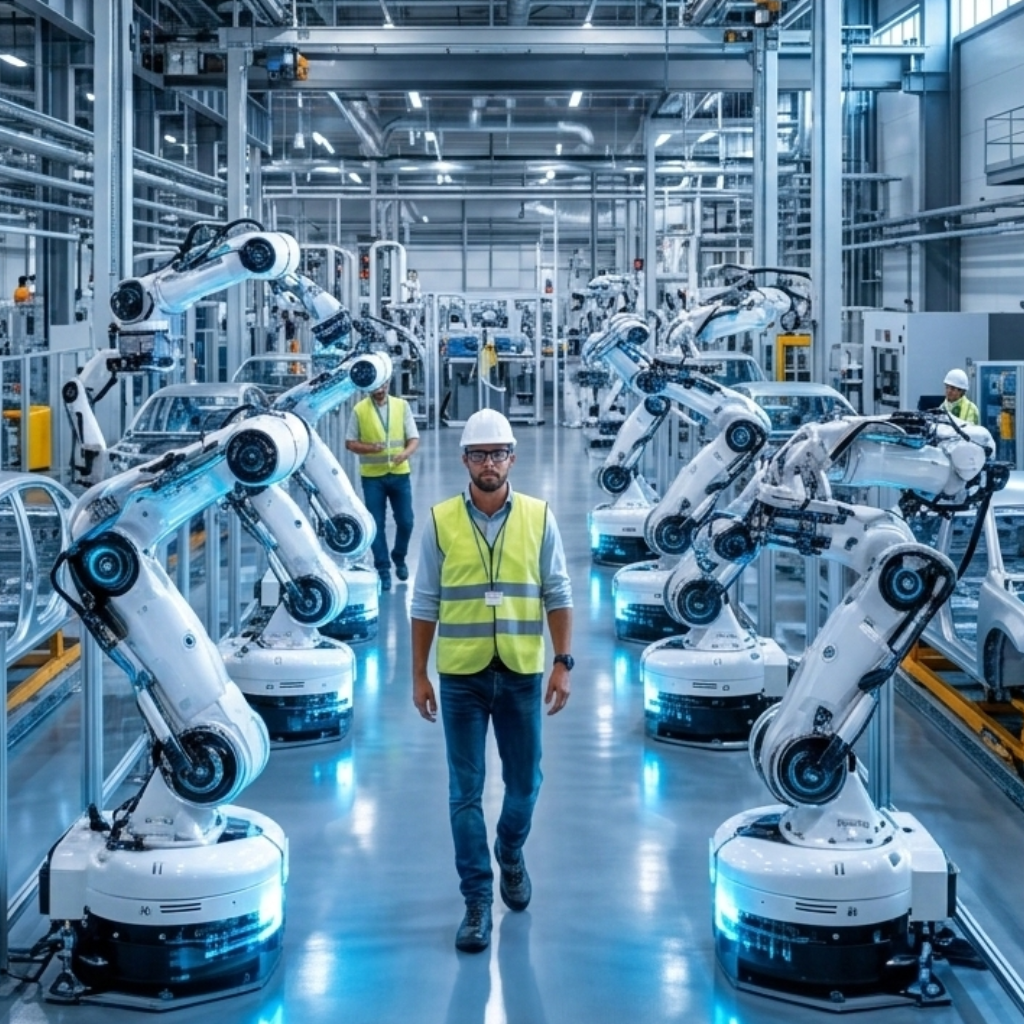
For a long time, the industrial engineer was the driving force behind operational performance. Their role involved optimizing production processes, reducing costs, improving quality, and streamlining workflow on the factory floor. Lean management, continuous improvement, time and motion studies, and statistical quality control were the tools that shaped their daily work. The goal was clear: to produce better, faster, and at a lower cost.
But this vision, centered on the mechanical optimization of processes, has undergone a profound transformation in recent years. The globalization of value chains, geopolitical tensions, the energy transition, stricter environmental requirements, product customization, and market volatility have upended the balance of the industrial landscape. The factory is no longer a closed system; it is connected to global networks, digital flows, and real-time data platforms.
At the same time, the digital transformation of industry—often referred to as Industry 4.0—has accelerated the widespread integration of sensors, collaborative robots, cyber-physical systems, and analytics platforms. Production lines now generate vast amounts of data from machines, IoT sensors, ERP systems, and monitoring software. According to the World Economic Forum, the widespread adoption of Industry 4.0 technologies could generate up to $3.7 trillion in annual value by 2025, particularly through artificial intelligence, advanced automation, andintelligent robotics¹.
In this context, industrial complexity is skyrocketing. A single production facility may incorporate hundreds of interconnected pieces of equipment, rely on international suppliers, operate under fluctuating energy constraints, and be exposed to cyber risks. Industrial engineers no longer manage only physical processes; they now oversee a hybrid ecosystem where data, machines, and people interact constantly.
The figures illustrate this shift:
- Global investment in industrial robotics now exceeds tens of billions of dollars annually, with sustained growth in the automotive, electronics, and logistics sectors.
- Predictive maintenance powered by artificial intelligence can reduce unplanned downtime by up to 30% in certain heavy industries.
- Companies that have undertaken an advanced digital transformation are seeing significant productivity gains, sometimes exceeding 20%, according to several industry studies.
The profession is thus entering a new era. It is no longer just a matter of optimizing a production line, but of managing an intelligent, interconnected, and scalable system. The industrial engineer is becoming a strategic player in digital transformation, at the intersection of operational performance, data science, and advanced robotics.
How AI is integrated into industrial processes
Artificial intelligence is now integral to every stage of the industrial system. It is no longer limited to automating repetitive tasks; it is transforming the way production is designed, optimized, and secured. In the connected factory, sensors, robots, monitoring systems, and analytics platforms generate a continuous stream of data. AI acts as a cross-functional layer of intelligence, capable of anticipating failures, optimizing settings in real time, and simulating complex scenarios. Industrial engineers now operate in an environment where performance depends as much on mastering algorithms as on understanding physical processes.
There are many key drivers of integration:
- Augmented predictive maintenance: Machine learning models analyze equipment vibrations, temperatures, pressures, and usage cycles to detect anomalies before a failure occurs. Whereas preventive maintenance relied on fixed intervals, predictive maintenance is based on the actual condition of the machines. Some industry studies show that these approaches can reduce unplanned downtime by up to 30% and lower maintenance costs by 10 to20%¹. Engineers no longer simply schedule maintenance; they manage failure probabilities.
- Digital twins and advanced simulation: Digital twins create a virtual replica of a production line or an entire factory. AI uses them to test scenarios involving optimization, changes in production rates, the integration of a new robot, and variations in energy flows—all without disrupting actual production. These simulations make it possible to anticipate operational impacts and refine strategic decisions before implementing them.
- Collaborative robotics and real-time adaptation: Next-generation industrial robots, known as cobots, interact with human operators. Using computer vision and machine learning, they adjust their movements, detect defects, and adapt their behavior to changes in production. AI helps optimize motion paths, reduce cycle times, and improve operator safety.
- Smart Energy Optimization: Industrial systems account for a significant portion of global energy consumption. Predictive algorithms analyze consumption peaks, optimize the use of energy-intensive equipment, and adjust production cycles to reduce the carbon footprint. This aspect is becoming strategic in the context of the energy transition and rising energy costs.
- Automated quality control using machine vision: High-resolution cameras paired with AI models detect defects invisible to the human eye on high-speed production lines. This automated inspection improves quality consistency and reduces scrap, while providing immediate feedback to production teams.
- Smart Industrial Cybersecurity: As equipment becomes increasingly connected, factories are becoming potential targets for cyberattacks. AI enables continuous monitoring of industrial network traffic, identifies abnormal behavior, and prevents intrusions that could disrupt production.
These practices are profoundly transforming industrial decision-making. Factories are becoming less reactive and more predictive. Industrial engineers no longer simply improve existing processes; they manage dynamic systems capable of continuously learning and adapting. However, this increased reliance on data and algorithms requires rigorous control over models, their reliability, and their governance.
A new role for the industrial engineer
The integration of artificial intelligence into production systems is not only transforming the tools available to industrial engineers; it is also fundamentally redefining their professional role. Whereas they were historically experts in workflows, methods, and process optimization, they are now becoming architects of intelligent systems, responsible for ensuring coherence between machines, data, and strategic decisions.
Industrial engineers are no longer focused solely on continuous improvement in the traditional sense. They now manage environments capable of learning, anticipating, and partially self-optimizing. Performance is no longer based solely on static metrics, but on dynamic models fueled by massive data streams.
This transformation is evident on several levels:
- Monitoring Smart Systems: Production lines incorporate optimization algorithms, predictive maintenance systems, and automated planning tools. Engineers must understand these models, assess their relevance, and make decisions when algorithmic recommendations conflict with operational realities.
- Human-Machine Coordination: With the rise of collaborative robots, industrial engineers are now responsible for striking a balance between automation and human intervention. They must design environments where technology enhances safety and productivity without dehumanizing the workforce.
- Data-Driven Decision-Making: Strategic decisions, production schedules, resource allocation, and the integration of new equipment are now based on predictive dashboards. Engineers must interpret complex indicators, identify relevant correlations, and avoid biases caused by poorly calibrated models.
- Technological Responsibility and Cybersecurity: The widespread adoption of connected systems exposes infrastructure to digital vulnerabilities. Industrial engineers now play a role in securing these architectures, working in collaboration with IT and cybersecurity teams.
- Contribution to the overall industrial strategy: Industrial engineers are becoming key players in the digital transformation of companies. Their role is no longer limited to the factory floor; they contribute to investment decisions, the energy transition, and the integration of new technologies into the value chain.
This shift is strengthening the strategic importance of the profession. According to the World Economic Forum, skills related to industrial data analysis and the management of automated systems are among the most in-demand in the manufacturing sector by2030¹.
Thus, the industrial engineer of tomorrow will not be replaced by artificial intelligence. Instead, the role will be redefined by the engineer’s ability to understand its mechanisms, oversee its use, and manage its integration to drive sustainable performance. The value of the profession will no longer lie solely in process optimization, but in the ability to design intelligent, resilient, and responsible industrial systems.
What skills does an industrial engineer need in the age of AI?
The fundamentals of industrial engineering—mastery of production processes, workflow optimization, quality management, and time and motion analysis—remain the essential foundation of the profession. Methodological rigor, a deep understanding of mechanical systems, and a culture of continuous improvement have not disappeared in the digital age. However, the growing integration of artificial intelligence into factories requires a significant expansion of the scope of expertise. Engineers must no longer merely understand the production line; they must also understand the intelligent systems that analyze, optimize, and sometimes control it.
This shift is transforming training, professional attitudes, and industrial culture itself.
Technical and digital skills
- Understanding the principles of machine learning as applied to industry: Without becoming a data scientist, industrial engineers must grasp the fundamental concepts of predictive models—including classification, regression, and anomaly detection—as well as key performance metrics (accuracy, recall, and error rate). They must understand how data from industrial sensors feeds into these models.
- Assessing an algorithm’s robustness in a real-world environment: A model that performs well during the pilot phase may prove less effective under actual industrial conditions, which are subject to fluctuations in temperature, production rate, or material quality. Engineers must be able to interpret technical metrics and assess their operational impact.
- Mastering cyber-physical systems and the Industrial Internet of Things: Connected devices generate continuous streams of data. Engineers must understand their architecture, interconnections, and vulnerabilities.
- Interpreting complex predictive dashboards: Predictive maintenance, energy optimization, and machine performance analysis—these tools require a critical and context-sensitive analysis.
According to the World Economic Forum, skills related to industrial data analysis and advanced automation are among those experiencing the strongest growth in manufacturing occupations by2030¹.
Cognitive and decision-making skills
The augmented industrial environment is profoundly changing the dynamics of decision-making.
- Remain vigilant against excessive automation: The risk of algorithmic dependence also exists in industry. A recommendation generated by an optimization system should not be implemented without critical analysis.
- Knowing how to regain control in the event of a system malfunction: In the event of a software failure or a predictive error, the engineer must be able to revert to a traditional process-based analysis and ensure production safety.
- Managing complex and interdependent environments: Decisions made on one production line can affect energy consumption, internal logistics, or maintenance. Engineers must think in a systems-oriented way.
- Developing a probabilistic approach to performance: AI introduces probability scores and predictive models. Engineers must incorporate these metrics without reducing industrial decision-making to mere statistical automation.
Ethical, regulatory, and safety competencies
Industry 4.0 is not just about performance; it also entails new responsibilities.
- Understanding the regulatory frameworks governing automated systems: Industry standards, machine safety, cybersecurity, and data compliance—these aspects are becoming central.
- Ensuring the traceability of automated decisions: In the event of an industrial incident, it is essential to document the decisions made, whether by humans or algorithms.
- Ensuring the cybersecurity of industrial infrastructure: Connected factories are vulnerable to cyberattacks. Engineers must take this into account when designing systems.
- Integrating environmental considerations: Energy optimization and carbon footprint reduction are becoming data-driven strategic indicators.
Interpersonal and interdisciplinary skills
The augmented industrial engineer no longer works in isolation.
- Collaborating with data scientists and IT experts: Mutual understanding between process engineering and data science is becoming a key factor for success.
- Managing hybrid human-robot teams: Collaborative robotics requires a new approach to managing interactions between operators and intelligent machines.
- Supporting team transformation: The introduction of AI is changing shop floor roles. Engineers must take a leading role in training and driving change.
The industrial engineer of tomorrow will not be replaced by artificial intelligence. Instead, their role will be redefined by their ability to understand, manage, and orchestrate intelligent industrial systems. The value of the profession will no longer lie solely in process optimization, but in the ability to design adaptive, secure, and sustainable production environments.
Can artificial intelligence make the industry more efficient and safer?
One of the key arguments in favor of artificial intelligence in industry is its ability to reduce human error and technical failures, which are the primary causes of production downtime, industrial accidents, and quality losses. In an environment where production lines operate at high speeds and under significant economic pressure, even the slightest failure can result in considerable costs. Human error, operator fatigue, improper machine calibration, and delayed detection of anomalies are among the recurring factors contributing to industrial incidents.
In this context, AI emerges as a tool capable of simultaneously enhancing performance and security by functioning as a continuous, analytical, and predictive monitoring system.
Specific examples:
- Predictive maintenance and reduction of unplanned downtime: Machine learning models detect subtle signals in equipment vibrations, temperatures, or operating cycles. These systems enable action to be taken before a critical failure occurs, significantly reducing unplanned downtime andassociated losses¹.
- Optimization of production rates: Optimization algorithms analyze production parameters in real time and adjust settings to maximize output while minimizing defects. This ability to make dynamic adjustments improves overall equipment effectiveness and reduces scrap.
- Automated quality control using machine vision: AI-powered machine vision systems inspect thousands of parts at high speed, detecting micro-defects invisible to the human eye. This improves quality consistency and reduces product returns.
- Accident prevention and operator safety: Smart systems can analyze video feeds in workshops and detect risky behavior or intrusions into hazardous areas, thereby enhancing workplace safety.
- Energy optimization and emissions reduction: Predictive models enable the adjustment of machinery energy consumption based on actual needs, helping to reduce costs and the carbon footprint.
These advances suggest that artificial intelligence can boost productivity, improve quality, and enhance safety in industrial settings. It enables the continuous analysis of data volumes that would be impossible to process manually and helps identify trends that are invisible to the human eye.
However, these promises should be viewed with caution.
AI also introduces new risks:
- Algorithmic dependency: Overreliance on automated systems can reduce human vigilance and undermine the ability to respond to unexpected anomalies.
- Industrial black-box effect: Decisions made by complex models can be difficult to explain, which complicates the analysis of causes in the event of an incident.
- Cybersecurity Vulnerabilities: The increasing interconnectivity of equipment exposes infrastructure to the risk of cyberattacks that could paralyze production.
- Systemic risk: If multiple industrial sites adopt similar architectures, a software vulnerability could have far-reaching consequences.
The challenge is therefore twofold. Artificial intelligence can enhance industrial performance and safety, but only if it remains supervised, audited, and integrated into a rigorous technology governance framework. Sustainable performance depends not only on the power of algorithms, but also on the industrial engineer’s ability to understand their limitations and maintain meaningful human oversight.
Industry 4.0 will not be safer simply because it is more automated. It will be safer because intelligent systems will be designed to complement human judgment, not to replace it.
What will the role of an industrial engineer look like in the future?
The industrial engineer of 2035 will work in a fully connected production environment, driven by real-time analytics platforms and fueled by continuous data streams from machines, robots, sensors, and information systems. The factory will become an integrated cyber-physical system, capable of self-monitoring, partial self-optimization, and continuous simulation thanks to digital twins.
The role of the engineer will gradually shift from local optimization to the strategic oversight of complex intelligent systems. It will no longer be solely about improving an existing process, but about orchestrating a dynamic industrial ecosystem, where performance depends on the seamless interaction between data, robotics, and human expertise.
Several trends are already evident or gaining momentum:
- Self-adaptive production lines: AI systems will automatically adjust production parameters based on demand, machine status, or energy constraints, reducing downtime and optimizing output.
- Real-time digital twins: Every piece of equipment or production line can be replicated virtually. Engineers will be able to test modifications, integrate a new robot, or analyze the impact of a change in production rate in a simulated environment before implementing any changes in the real world.
- Advanced collaborative robotics: Cobots will interact safely with human operators, adapting their paths and tasks as needed. Engineers will need to design environments where human-machine cooperation maximizes productivity while ensuring safety.
- Fully predictive and automated maintenance: Algorithms will anticipate failures with greater accuracy, automatically triggering scheduled maintenance and optimizing equipment availability.
- Integrated smart energy management: Industrial systems will adjust energy consumption based on peak rates, environmental constraints, and decarbonization goals, contributing to a more sustainable industry.
- The emergence of hybrid roles: Engineers specializing in industrial data, cybersecurity for critical infrastructure, or governance of smart systems will begin to appear within organizations.
However, despite these technological advances, one thing is clear: industrial engineering will remain a profession that requires judgment and responsibility. Artificial intelligence can optimize, simulate, and predict, but it does not understand the broader strategic issues, human decision-making, or the social dimensions of industrial transformation.
In an environment where automation will continue to grow, it is precisely the engineer’s ability to think systemically, anticipate risks, balance performance and safety, and support teams through change that will make the difference. Human expertise is not disappearing; rather, it is shifting toward tasks of high strategic and organizational value.
The industrial engineer of tomorrow will not be competing with machines. Instead, they will ensure their consistency, safety, and responsible integration into the company. In an increasingly smart industry, technology will accelerate optimization, but the final decision will remain a human one, based on a comprehensive understanding of the system and professional responsibility.
Toward an augmented industry that remains human
Artificial intelligence is profoundly transforming industrial systems, but it does not alter their fundamental purpose. It accelerates data analysis, optimizes processes, improves maintenance, enhances quality, and streamlines the coordination of production lines. It shifts priorities: less reactive correction, more predictive foresight; fewer empirical adjustments, more data-driven decision-making. Yet, at the heart of this transformation, one constant remains: industrial production remains a strategic and human endeavor.
Augmented industry is not simply an automated industry without oversight. It is based on a structured partnership between technical expertise and computational power. The algorithm identifies correlations in millions of data points; the engineer assesses their operational relevance. The machine optimizes parameters; the human balances performance, safety, cost, and environmental impact. The technology adjusts production rates; the engineer understands the overall consequences for the organization and teams.
This distinction is crucial. An industrial decision is not merely a matter of optimization. It involves investments, jobs, environmental responsibilities, and sometimes the safety of thousands of people. It requires a systemic vision, an understanding of risks, and the ability to make trade-offs—aspects that no statistical model, however sophisticated, can handle on its own.
The challenge in the coming years will therefore not be whether artificial intelligence will replace industrial engineers, but how to structure its integration in a responsible, transparent, and secure manner. This involves:
- Rigorous validation of systems prior to their large-scale deployment.
- Continuing education for engineers on data and cybersecurity issues.
- Transparent governance of industrial data and algorithms.
- Constant human oversight of decisions with significant operational impact.
Augmented industry also offers significant opportunities. It can improve operator safety, reduce the carbon footprint of industrial sites, optimize energy consumption, and strengthen the resilience of production chains in the face of crises. It can become a driver of sustainable competitiveness, provided that the technologies are used to support a comprehensive strategy rather than merely short-term automation.
Ultimately, the transformation currently underway goes beyond industrial engineering alone. It raises questions about the role of humans in a production system where data is becoming ubiquitous. It requires us to redefine expertise—no longer merely as mastery of technical processes, but as the ability to manage intelligent systems with discernment, responsibility, and strategic vision.
In an increasingly connected industry, the value of an industrial engineer will not be measured by their ability to compete with algorithms, but by their ability to make sense of them. Machines can optimize faster. Engineers, on the other hand, must continue to make the right decisions.
What if, deep down, the true revolution brought about by artificial intelligence in industry isn’t about replacing engineers, but rather about revealing what lies at the heart of the profession: the ability to design, anticipate, and guide a complex system toward sustainable and responsible performance?
Learn more
To broaden your perspective and understand how AI is reshaping other professions—from human resources to finance, and from healthcare to communications—we invite you to explore our dedicated section “AI & Professions”, which analyzes the concrete impact of intelligent technologies on skills, practices, and the organization of work.
References
1. World Economic Forum. (2023). Shaping the Future of Advanced Manufacturing and Value Chains.
https://www.weforum.org
2. McKinsey & Company. (2022). The value of predictive maintenance in advanced manufacturing.
https://www.mckinsey.com
3. World Economic Forum. (2023). Future of Jobs Report – Manufacturing and Production roles.
https://www.weforum.org
4. World Economic Forum. (2023). Future of Jobs Report – Manufacturing and Production roles.
https://www.weforum.org
5. McKinsey & Company. (2022). The value of predictive maintenance in advanced manufacturing.
https://www.mckinsey.com