


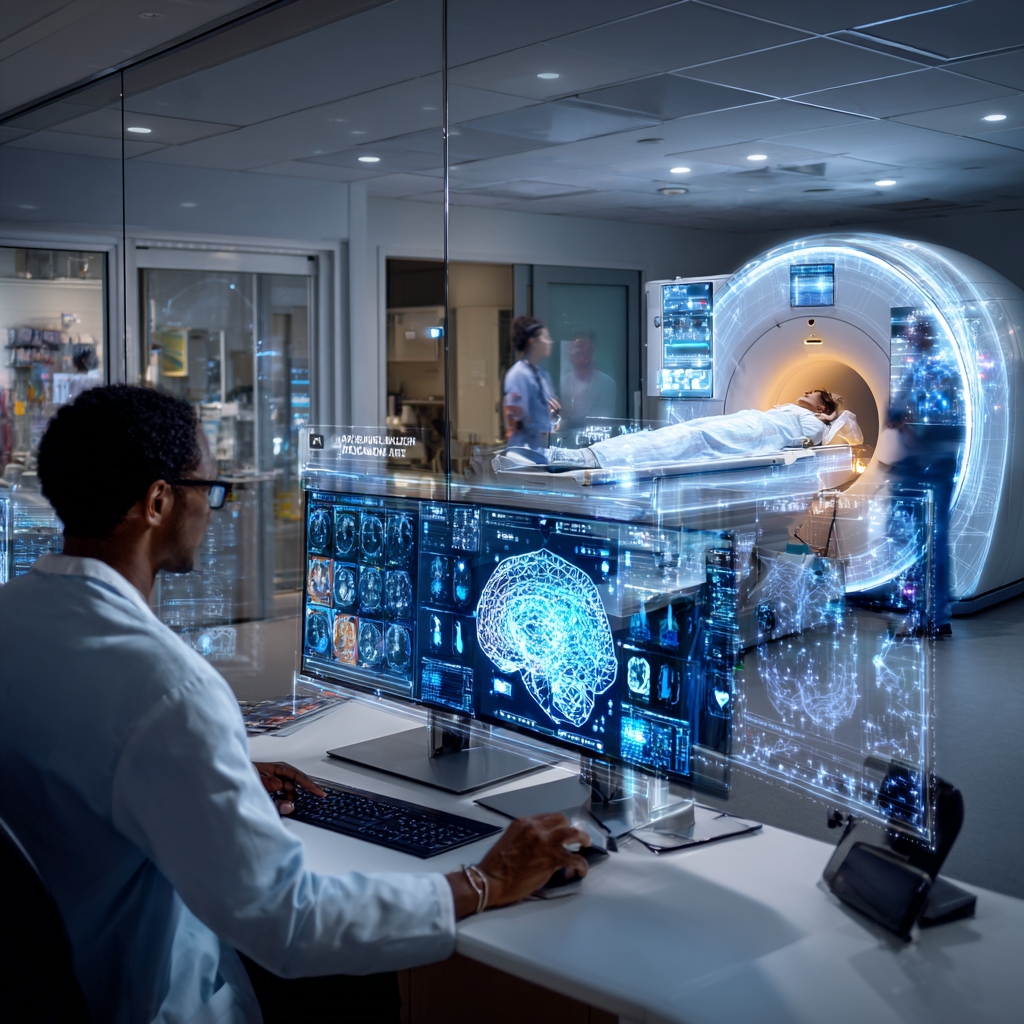
For a long time, radiology was viewed as a medical specialty focused on interpreting images to aid in diagnosis and treatment monitoring. The radiologist was the “expert reader” of CT scans, MRIs, X-rays, and ultrasounds, capable of identifying abnormalities sometimes invisible to the untrained eye, and then translating them into clinical hypotheses useful for the patient’s care pathway. But this view, based on a comprehensive human interpretation of the exams, now faces a structural reality: medical imaging is producing more and more images, faster and faster, in a healthcare system where demand is growing faster than available resources.
An aging population, rising cancer rates, the rise of personalized medicine, an increase in preventive screenings, and the growing prevalence of chronic diseases are all contributing to the continued rise in the use of medical imaging. At the same time, hospital emergency departments are increasingly relying on rapid imaging tests (brain CT scans, CT angiography, chest CT scans), while oncology requires repeated, comparative, and quantified follow-ups. According to several analyses, the growth in imaging volume exceeds that of the number of radiologists in many countries, contributing to sustained pressure on turnaround times and the cognitive load ofpractitioners¹. In some settings, radiologists no longer deal with just a few images, but with hundreds, sometimes thousands of images per exam, which changes the very nature of the attention required.
In this context, complexity is skyrocketing. Imaging studies are becoming more sophisticated (multiparametric MRI sequences, functional imaging, 3D reconstructions), clinical contexts more demanding (rapid treatment decisions, multidisciplinary consultations), and expectations higher (quality, traceability, standardization). At the same time, radiology is undergoing a complete digital transformation: PACS archives, patient records, biological data, medical histories, and previous reports—everything converges into an ecosystem where data accumulates and where value depends on the ability to sort, prioritize, and compare. It is precisely in this gap that artificial intelligence comes into play, not as a replacement, but as a layer of assistance, capable of detecting, quantifying, prioritizing, and sometimes proposing hypotheses regarding volumes of images that have become difficult for humans to process².
The figures illustrate this shift:
- The global market for artificial intelligence in medical imaging is growing rapidly and could reach tens of billions of dollars by 2030, driven by diagnostic support, prioritization, and the automation ofpost-processing tasks³.
- Clinical studies have shown that, for specific tasks (such as detecting certain cancers through imaging), AI systems can achieve performance levels comparable to those of experts, especially when used as a second reader or screening tool undermedical supervision⁴.
- The World Health Organization emphasizes that the deployment of AI in healthcare is only valuable if it enhances patient safety, transparency, and clinical accountability, which places the radiologist at the center of the governance of thesetools⁵.
The profession is thus entering a new era. It is no longer just about interpreting images, but about driving an augmented diagnostic process based on massive data streams, real-time prioritization, and close collaboration between human expertise and algorithms—all while meeting heightened standards for quality, explainability, and trust.
How AI Is Being Integrated into Medical Imaging
Artificial intelligence is no longer limited to experimental projects in radiology. It is now gradually being integrated into every stage of the imaging process, from image acquisition to report writing. It is transforming the way abnormalities are detected, prioritized, quantified, and documented. Whereas radiologists once analyzed a growing volume of images on their own, they now work in an environment where algorithmic systems filter, flag, and prioritize information. This evolution does not eliminate human expertise; rather, it redefines its key areas of focus.
The most transformative use cases illustrate this shift:
- Automated anomaly detection: Convolutional neural networks are capable of identifying anatomical structures and detecting anomalies in complex images (lung nodules, hairline fractures, breast microcalcifications). In breast cancer screening, some studies have shown that using an AI system as a second reader helps maintain diagnostic sensitivity while reducing the workload onhuman readers⁶. Here, AI acts as an early warning tool, drawing attention to areas that require closer examination.
- Prioritization of urgent cases (intelligent triage): In emergency departments, rapid interpretation is crucial. AI systems can automatically analyze a brain scan and detect a suspected intracranial hemorrhage in a matter of seconds, triggering apriority alert⁷. This algorithmic triage reduces the time between image acquisition and treatment, a critical factor in stroke prognosis.
- Automated quantification and longitudinal monitoring: AI excels at precise and reproducible measurements. It can automatically segment a tumor, calculate its volume, and compare its changes between two examinations conducted at different times. This standardization improves the consistency of cancer monitoring and reduces inter-observer variability, a recognized challenge inclinical radiology⁸.
- Reducing errors caused by cognitive fatigue: Analyzing repetitive images exposes radiologists to the risk of visual and decision-making fatigue. Studies published in *Nature Medicine* suggest that the human-machine collaboration improves overall performance compared to either approach usedalone⁹. AI can thus serve as a safety net, limiting unintentional oversights.
- Automated generation of structured reports: Some tools incorporate natural language processing modules capable of generating standardized report structures. This facilitates traceability, interoperability, and the secondary use of clinical data, particularly for research purposes or to support continuous improvement ofclinical practices¹⁰.
These applications are fundamentally transforming daily practice. Radiology is becoming less sequential and more interactive, centered on an ongoing dialogue between human expertise and algorithmic analysis. However, this integration also increases reliance on the quality of training data, the clinical validation of tools, and the radiologist’s ability to critically evaluate the results produced.
A new role for the radiologist
The integration of artificial intelligence into medical imaging is not only redefining the tools available to radiologists; it is also profoundly transforming their professional role. Whereas they were historically viewed as image experts, primarily involved in the post-examination phase, they are gradually becoming central players in a digital ecosystem, responsible for the validation, interpretation, and governance of algorithmic systems integrated into the care pathway.
This shift does not represent a replacement, but rather a shift in focus. Radiologists no longer simply identify abnormalities; they assess probabilities, weigh the hypotheses generated by a system, and assume ultimate responsibility for a diagnosis that determines the course of treatment.
In practical terms, this new role involves several key aspects:
- Algorithm oversight and validation: AI systems generate scores, heat maps, and probabilities of pathology. The radiologist must interpret these signals, distinguish false positives from relevant alerts, and verify that the algorithm has not been misled by artifacts or atypical anatomical variations. Medical decisions remain the responsibility of humans, as does legal liability.
- Expanded clinical integration: AI analyzes images. The radiologist, on the other hand, takes into account the clinical context, medical history, laboratory data, and the patient’s progression over time. The radiologist serves as the interface between algorithmic analysis and the patient’s actual condition, ensuring a comprehensive and holistic interpretation.
- Educational guidance for staff and patients: The use of AI raises questions. How does the tool work? Can we trust it? Radiologists must be able to explain the role of algorithmic assistance in their diagnosis without causing confusion or shifting responsibility to the machine.
- Involvement in technology governance: In many institutions, radiologists now participate in committees evaluating AI solutions, in clinical validation phases, and in implementation protocols. They are becoming key decision-makers in technology choices, rather than mere users.
- Contributing to research and continuous improvement: AI systems require annotated data and feedback. Radiologists play a key role in improving these models by helping to expand training datasets and evaluating performance in real-world settings.
This transformation is also changing the timeline of the profession. Whereas radiologists used to be involved only after images were acquired, they can now be involved both upstream—in optimizing imaging protocols—and downstream—in analyzing the performance of the tools deployed.
However, this change is not without consequences. It entails:
- Greater liability in cases of AI-assisted errors.
- The need for ongoing training in light of rapidly evolving tools.
- Ethical scrutiny of algorithmic biases and performance equity across different populations.
According to the World Health Organization, the integration of AI in healthcare requires that professionals maintain meaningful human oversight and ensure transparency in decision-making⁵. In this context, the radiologist becomes the guardian of keeping the human element at the center of the diagnostic process.
Thus, the profession is not disappearing; it is evolving. The radiologist of the future will not be merely a machine-assisted image reader, but a supervisor of intelligent systems, an interpreter of probabilities, and a clinician with expanded responsibilities, whose expertise now extends to a critical understanding of the digital tools they use.
What skills does a radiologist need in the age of AI?
The fundamentals of the radiologist’s profession—mastery of anatomy, understanding of pathophysiological mechanisms, the ability to conduct detailed semiological analysis, and structured clinical reasoning—remain the indispensable foundation of the practice. Medical responsibility, the ethics of care, and scientific rigor do not disappear in the digital age. However, the growing integration of artificial intelligence requires a significant expansion of the scope of expertise. Radiologists must no longer merely understand the image; they must also understand the system that analyzes it.
This shift is transforming training, professional conduct, and the culture of the profession.
Technical and digital skills
- Understanding the principles of machine learning: Without becoming a data scientist, radiologists must grasp the basics of neural networks, training datasets, performance metrics (sensitivity, specificity, AUC), and statistical limitations.
- Evaluating the quality of an algorithm in a real-world clinical setting: An algorithm that performs well in the laboratory may prove less robust in a hospital setting. Radiologists must be able to interpret published metrics and assess their applicability to their patient population.
- Analyzing decision-support interfaces: Heat maps, probability scores, and automatic segmentation—these tools must be evaluated critically and incorporated into the overall analysis.
- Identifying data biases: An algorithm trained primarily on data from a specific population may perform inconsistently across other demographic groups, raising concerns about diagnostic equity.
According to the European Society of Radiology, training in artificial intelligence is expected to become a core component of initial radiology training in the coming years¹¹.
Cognitive and decision-making skills
The augmented environment alters mental load and decision-making dynamics.
- Remaining vigilant in the face of automation: The risk of “automation bias” has been well-documented in medicine: when a machine suggests an answer, the healthcare professional may be tempted to accept it without questioning it.
- Knowing how to regain control in the event of an algorithmic error: A false negative in lesion detection can have serious consequences. The radiologist must maintain critical autonomy at all times.
- Managing conflicting signals: There may be instanceswhere clinical intuition contradicts the calculated probability. Human judgment remains the final arbiter.
- Developing a probabilistic approach to diagnosis: AI introduces a culture of scoring and probability. Radiologists must incorporate this dimension without reducing the diagnosis to a mere statistical result.
A study published in *Nature Medicine* highlights that optimal performance is achieved when the final decision results from structured human-machine collaboration rather thancomplete delegation⁹.
Ethical, Legal, and Regulatory Competencies
AI in healthcare is classified as a high-risk application under European regulatory frameworks. This places greater responsibility on the professionals who use it.
- Understanding the European regulatory framework: The European AI Act classifies medical devices incorporating AI as systems subject to high standards of safety, transparency, and traceability.
- Ensuring the traceability of decisions: In the event of a diagnostic error, it is essential to be able to document the respective contributions of human analysis and algorithmic assistance.
- Ensuring transparency with patients: Trust is built on clarity. Patients must understand that AI assists doctors, but does not replace them.
- Contributing to hospital-wide ethical discussions: From the deployment of tools and the selection of vendors to clinical validation and performance audits, radiologists must play an active role in technology governance.
The World Health Organization emphasizes that AI in healthcare must adhere to the principles of accountability, inclusivity, andconstant human oversight⁵.
Interpersonal and interdisciplinary skills
Augmented radiology is not an isolated discipline.
- Collaborating with data scientists and biomedical engineers: Mutual understanding between clinicians and technicians is becoming essential.
- Participate in data-driven multidisciplinary teams: Oncologists, surgeons, biologists, and radiologists now share quantified metrics generated by intelligent systems.
- Contributing to the training of the next generation: Young doctors will need to be trained in hybrid radiology, which combines clinical and digital approaches.
According to a forward-looking analysis by the World Economic Forum on healthcare professions, advanced digital skills will be among the fastest-growing areas in the medical sector by2030¹².
The radiologist of the future will not be replaced by artificial intelligence. Instead, their role will be redefined by their ability to understand, manage, and master the digital tools that enhance their practice. Value will no longer lie solely in the ability to interpret images, but in the ability to orchestrate a complex diagnostic environment, where technology serves as a tool rather than a substitute.
Can artificial intelligence make diagnoses more reliable?
One of the main arguments in favor of artificial intelligence in radiology is its ability to reduce human error. In medicine, diagnostic error remains a well-documented reality. Cognitive fatigue, examination overload, inter-observer variability, and time pressure can all affect clinical performance. Some international estimates suggest that diagnostic errors contribute significantly to serious adverse events inhealthcare systems¹³. In this context, AI emerges as a tool capable of enhancing safety by acting as a systematic and tireless second reader.
Specific examples:
- Breast cancer screening: Studies published in *Nature* have shown that an AI system used in conjunction with a radiologist can reduce false negatives and false positives in certain screening settings, improving overall sensitivity while reducing the workload ofinterpreting images⁴. The human-machine combination has demonstrated superior performance to that of either one alone in several controlled trials.
- Detection of strokes: Algorithms for the automatic analysis of brain CT scans can identify intracranial hemorrhages or arterial occlusions in a matter of seconds, reducing response times and improving the speed of treatment—a key factor in neurological prognosis⁷.
- Analysis of lung images: During the COVID-19 pandemic, certain AI systems were used to automatically quantify lung involvement on chest CT scans, facilitating patient triage and monitoring of disease progression in settings wherehospitals were under significant strain¹⁴.
- Reduced inter-observer variability: Automated segmentation of tumor lesions or organs enables reproducible measurements, minimizing differences in interpretation among clinicians and improving the consistency oftreatment decisions⁸.
These advances suggest that AI can help improve the accuracy, speed, and standardization of diagnosis. It enables the analysis of massive volumes of images, the identification of subtle signs, and the maintenance of constant vigilance—areas where humans may be affected by fatigue or cognitive load.
However, these promises should be viewed with caution.
AI also introduces new risks:
- Algorithmic bias: A model trained on datasets derived primarily from a specific population may perform less well on other demographic groups, raising concerns about diagnostic equity.
- The black-box effect: Some complex algorithms produce results that are difficult to explain. Yet in medicine, decisions must be justifiable and understandable.
- Cognitive dependence on automation: Automation bias can lead to overconfidence in algorithmic recommendations, reducing the practitioner’s critical vigilance.
- Medical-legal liability: In the event of an AI-assisted error, legal liability remains with the human. The radiologist cannot delegate their decision to a system.
The challenge is therefore twofold. Artificial intelligence can improve diagnostic accuracy, but only if it is used as a support tool, under constant supervision, clinically validated, and regularly audited. As the World Health Organization emphasizes, AI in healthcare must remain explainable, transparent, and human-centered⁵.
Diagnostic reliability depends not only on algorithmic performance, but also on the quality of the interaction between human expertise and artificial intelligence. It is not the machine alone that improves safety; rather, it is the way the radiologist integrates it into their clinical reasoning.
What will the field of radiology look like in the future?
By 2035, radiologists will work in a fully digital, interconnected environment with real-time assistance. Imaging suites will be integrated into intelligent platforms capable of instantly analyzing exams, automatically comparing the patient’s previous data, and suggesting prioritized diagnostic hypotheses. The radiologist’s role will gradually shift from exhaustive image review to strategic oversight, complex interpretation, and clinical coordination.
Several developments are already evident or currently being rolled out:
- Automatically prioritized test results: AI systems will sort test resultsbased on their level of urgency, identifying, for example, a suspected cerebral hemorrhage or pulmonary embolism within seconds, in order to immediately alert the relevant teams.
- Automated longitudinal comparison platforms: Intelligent tools will analyze the progression of a lesion over several years, detecting subtle changes invisible to the human eye, and providing quantified metrics integrated into the patient’s medical record.
- Enriched and interoperable reports: Reports will no longer be mere descriptive texts, but structured documents incorporating annotated images, automated measurements, and predictive indicators—all of which can be utilized by other medical specialties and clinical decision support systems.
- Greater integration into personalized care pathways: Imaging will become a cornerstone of precision medicine strategies, combining genetic, biological, and radiological data to refine treatments.
- New hybrid roles: Radiologists specializing in AI governance, clinical validation of algorithms, or medical data science will emerge in university hospitals and research centers.
However, despite these advances, there is a consensus in the scientific literature: human clinical judgment remains irreplaceable. AI excels at pattern recognition and quantification, but it does not understand a patient’s unique history, the nuances of the clinical context, or the human implications of a diagnostic finding.
In an environment where automation will continue to grow, it is precisely the radiologist’s ability to think in the face of uncertainty, to put probabilities into context, and to assume medical responsibility that will make all the difference. Human expertise is not disappearing; it is shifting toward tasks with greater cognitive and interpersonal value.
The radiologist of tomorrow will not be competing with machines. Instead, they will ensure that technology remains relevant, safe, and ethically integrated into patient care. In a field of medicine that is increasingly technology-driven, technology will speed up analysis, but decision-making will remain a profoundly human endeavor.
Toward an enhanced, yet still human, approach to radiology
Artificial intelligence is profoundly transforming medical imaging, but it does not alter its fundamental purpose. It speeds up analysis, improves detection, standardizes quantification, and enhances traceability. It shifts priorities: less repetitive image review, more comprehensive interpretation; less isolated decision-making, more interdisciplinary collaboration. Yet, at the heart of this transformation, one constant remains: diagnosis remains a medical act.
Augmented radiology is not automated radiology. It is based on a structured partnership between clinical expertise and computational power. The algorithm identifies correlations; the radiologist assesses their relevance. The machine calculates probabilities; the physician incorporates them into a care plan. Technology analyzes pixels; humans understand the patient.
This distinction is fundamental. A diagnosis is not merely the detection of an abnormality. It involves therapeutic decisions, sensitive disclosures, and sometimes life-altering choices. It requires an understanding of the patient’s context, history, vulnerabilities, and expectations. No statistical model, no matter how sophisticated, can on its own account for this relational and ethical dimension.
The challenge in the coming years will therefore not be whether AI will replace radiologists, but how to ensure that these tools are integrated in a responsible, transparent, and secure manner. This involves:
- Rigorous clinical validation of systems prior to deployment.
- Continuing education for healthcare professionals.
- Transparent governance of data and algorithms.
- Constant human oversight for high-stakes decisions.
Augmented radiology also offers significant opportunities. It can help reduce turnaround times for image interpretation, improve access to diagnosis in underserved areas, enhance early detection of diseases, and support more personalized medicine. It has the potential to promote equity, provided that its models are trained on representative data and evaluated independently.
Ultimately, the ongoing transformation extends beyond radiology alone. It raises questions about the role of physicians in an environment where data is becoming ubiquitous. It requires a redefinition of expertise—no longer merely as the accumulation of knowledge, but as the ability to manage intelligent systems in a critical and responsible manner.
In a medical field that is becoming increasingly technology-driven, the value of a radiologist will not be measured by their ability to compete with algorithms, but by their ability to interpret them. Machines can help us see things faster. Doctors, however, must continue to see things clearly.
What if, deep down, the true revolution of artificial intelligence in radiology isn’t about replacing human expertise, but rather about revealing its most essential qualities: discernment, responsibility, and attention to each patient?
Learn more
To broaden your perspective and understand how AI is reshaping other professions—from human resources to finance, and from healthcare to communications—we invite you to explore our dedicated section “AI & Professions”, which analyzes the concrete impact of intelligent technologies on skills, practices, and the organization of work.
References
1. The Royal College of Radiologists. (2023). Clinical Radiology UK Workforce Census 2022 Report.
https://www.rcr.ac.uk/publication/clinical-radiology-uk-workforce-census-2022-report
2. European Society of Radiology (ESR). (2019). What the radiologist should know about artificial intelligence (AI).
https://insightsimaging.springeropen.com/articles/10.1186/s13244-019-0738-2
3. Grand View Research. (2024). AI in Medical Imaging Market Size, Share & Trends.
https://www.grandviewresearch.com/industry-analysis/artificial-intelligence-ai-in-medical-imaging-market
4. McKinney, S. M. et al. (2020). International evaluation of an AI system for breast cancer screening. Nature.
https://www.nature.com/articles/s41586-019-1799-6
5. World Health Organization. (2021). Ethics and governance of artificial intelligence for health.
https://www.who.int/publications/i/item/9789240029200
6. McKinney, S. M. et al. (2020). International evaluation of an AI system for breast cancer screening. Nature.
https://www.nature.com/articles/s41586-019-1799-6
7. Chilamkurthy, S. et al. (2018). Deep learning algorithms for the detection of critical findings in head CT scans. The Lancet.
https://www.thelancet.com/journals/lanplh/article/PIIS2589-7500(18)30147-X
8. European Society of Radiology. (2022). Artificial intelligence in oncology imaging.
https://www.myesr.org
9. Esteva, A. et al. (2019). A guide to deep learning in healthcare. Nature Medicine.
https://www.nature.com/articles/s41591-018-0316-z
10. Pesapane, F. et al. (2020). Artificial intelligence as a medical device in radiology. Insights into Imaging.
https://insightsimaging.springeropen.com
11. European Society of Radiology. (2022). Training radiologists in artificial intelligence: European perspectives.
https://www.myesr.org
12. World Economic Forum. (2024). The Future of Jobs in Healthcare.
https://www.weforum.org
13. National Academies of Sciences. (2015). Improving Diagnosis in Health Care.
https://www.nationalacademies.org
14. Harmon, S. A. et al. (2020). Artificial intelligence for the detection of COVID-19 pneumonia on chest CT. Radiology.
https://pubs.rsna.org