


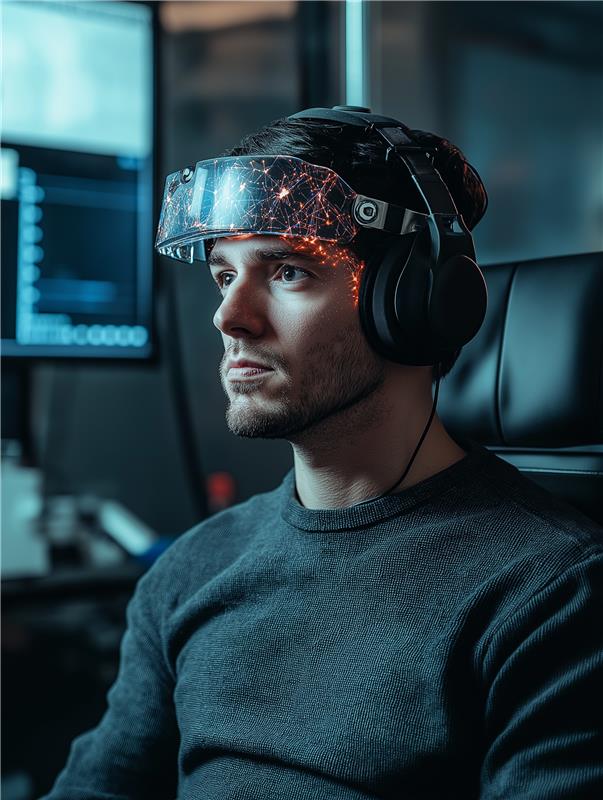
The launch of OpenAI’s new artificial intelligence marks a major turning point in the evolution of cognitive technologies. With this new AI capable of “seeing” and “thinking,” OpenAI has taken a decisive step forward, pushing the boundaries of artificial intelligence beyond simple textual capabilities. By combining advanced computer vision algorithms with natural language processing models, this AI is now capable of generating and interpreting images seamlessly, paving the way for a new generation of applications across various sectors.
But why is this AI considered a paradigm shift in AI research? How could its unique approach transform entire industries, from content creation to security?
AI capable of "seeing" and "thinking": the technical capabilities
This new AI from OpenAI is based on a hybrid model that combines textual and visual capabilities. Unlike existing AI systems, which are generally limited to analyzing a single type of data (text or images), OpenAI has developed an architecture that allows the AI to process both types of data simultaneously. This enables it not only to understand the context of images but also to associate complex interpretations with them, such as actions or abstract concepts.
The model uses an advanced approach combining convolutional neural networks (CNNs) for image analysis and transformers for natural language processing. Together, these technologies enable the AI to link visual elements to textual descriptions and make relevant associations. For example, the AI can generate images from a sentence such as “a cat walking on a roof at sunset,” or understand an image and provide a detailed explanation of it in text form.
OpenAI has overcome numerous technical challenges, including:
- The seamless integration of text and images without any loss of quality.
- Managing contextual complexity, such as identifying moving objects or subtle details in a variety of environments.
- Addressing algorithmic biases related to image interpretation, particularly in culturally or ethically sensitive contexts.
Practical applications in various fields
OpenAI’s AI opens up a wide range of possibilities in strategic sectors. Thanks to its ability to process both text and images, it stands out for its flexibility and effectiveness in complex contexts.
- Education: Imagine interactive educational tools that allow students to engage with visual content while receiving detailed explanations, both in text and through illustrations. This could transform the way we learn science, visual arts, or languages1.
- Security: In surveillance or quality control settings, AI could analyze images in real time to detect anomalies or suspicious objects in surveillance videos, thereby reducing the need for human intervention and speeding up emergency responses2.
- Entertainment: The video game and film industries could use this AI to generate visual scenes based on written scripts, thereby revolutionizing the production of audiovisual content. AI could also be used to create interactive experiences in which users actively participate in shaping the story.
The applications are vast and promise to transform professional practices in many fields by making interactions between humans and machines more natural and intuitive.
Impact on the creative and media industries
OpenAI’s ability to generate images from textual descriptions and analyze visuals opens up new opportunities in the creative industry. This innovation could redefine artistic production, advertising, fashion, and even journalism.
- Image and video creation: Artists and designers could use this technology to generate high-quality images or visuals based on abstract ideas or concepts3.
- Advertising and marketing: Advertising campaigns could become even more targeted through the use of images tailored to consumers’ specific expectations, generated in real time based on parameters defined by algorithms.
- Audiovisual production: The film and video game industries could benefit from this technology to quickly produce complex visual scenes, increasing production speed while maintaining high quality.
But this development also raises important questions regarding copyright, the authenticity of the generated content, and the legal challenges associated with machine-generated imagery.
The ethical risks and challenges of this new AI
While this AI offers fascinating possibilities, it also poses significant risks and ethical challenges. The following issues must be addressed to ensure the responsible deployment of this technology:
- Copyright and Intellectual Property: If an AI generates images, who is the true creator? The human artist, OpenAI, or the AI itself? Ownership of AI-generated images will need to be clarified to avoid legal disputes in the future4.
- Authenticity and fake news: This AI’s ability to generate realistic images could be exploited for malicious purposes, such as creating manipulated content intended to mislead the public5.
- Algorithmic biases and ethics: AI must be rigorously trained to avoid cultural or racial biases in image analysis, which requires strict oversight of the datasets used.
A step toward more "conscious" AI?
The launch of this AI by OpenAI marks a major turning point in the field of artificial intelligence. Thanks to its ability to merge text and images, it opens up new avenues for professional and creative applications. However, its deployment also raises ethical and legal questions that require careful consideration.
In the future, integrating this AI into real-world environments will require rigorous standards to ensure its responsible and beneficial use. Could this technology one day bring AI to a level of “visual awareness” that goes beyond current algorithmic processing?
References
1. UNESCO. (2023). Artificial Intelligence in Education: Challenges and Opportunities. https://unesdoc.unesco.org/ark:/48223/pf0000385722
2. Goodfellow, I., Bengio, Y., & Courville, A. (2016). Deep Learning. MIT Press. http://www.deeplearningbook.org
3. Ramesh, A. et al. (2022). Hierarchical Text-Conditional Image Generation with CLIP Latents. arXiv. https://arxiv.org/abs/2204.06125
4. European Parliament. (2023). Artificial Intelligence Act: Proposal for a Regulation. https://www.europarl.europa.eu/doceo/document/A-9-2023-0046_EN.html
5. Chesney, R., & Citron, D. (2019). Deep Fakes: A Looming Challenge for Privacy, Democracy, and National Security. California Law Review. https://papers.ssrn.com/sol3/papers.cfm?abstract_id=3213954