


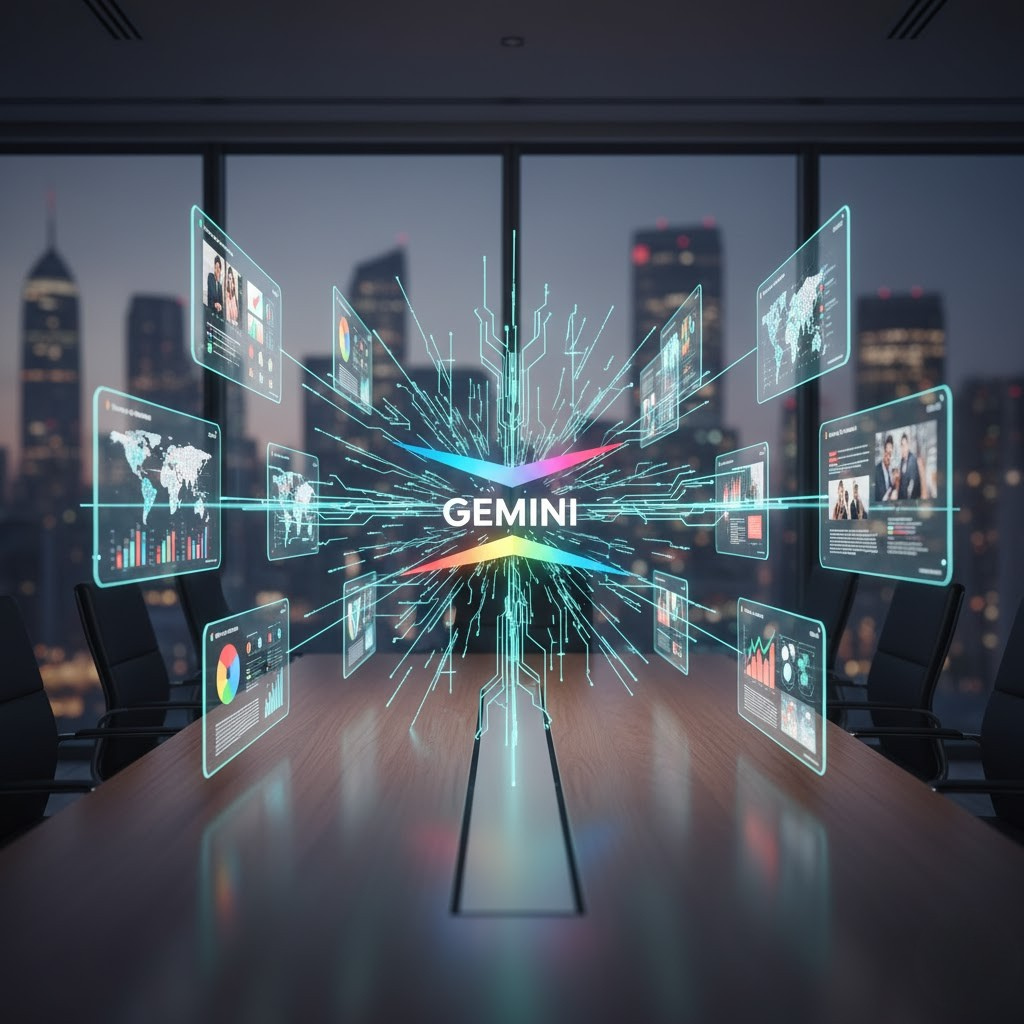
What if you could turn an idea into a complete presentation in just a few seconds? It’s now possible. Google has just introduced a brand-new feature to Gemini, its AI assistant: the automatic generation of slides and presentations from plain text. This is a major development for Google Workspace users, but it also sends a strong signal: the era of AI-generated creative documents has fully arrived in the workplace.
When productivity meets creativity
Google no longer wants to just help with writing or calculations. With Gemini, it wants to think and design on the user’s behalf. The tool, integrated into Google Slides, allows you to produce a complete presentation in just a few moments: simply type a prompt such as “Create a 10-slide presentation on the economic impacts of artificial intelligence, ” and Gemini automatically generates the titles, text, illustrations, and visual transitions. According to Google, this new feature is based on a multimodal architecture that combines text, images, and layout. It relies on the Gemini 1.5 Pro model, which is capable of understanding the context of a brief, identifying the expected logical structure (introduction, body, conclusion), and generating a coherent document in Slides format.
“We want to take AI from assistance to co-creation,” explains Aparna Pappu, vice president of Google Workspace. “Gemini doesn’t just write—it composes.”
A seamless experience in Google Workspace
The feature is accessible from Docs, Sheets, and Slides via the “Help me create” button. Users can enter a simple prompt, such as “Create an 8-slide presentation on cybersecurity challenges in 2025, ” and Gemini takes care of everything—from researching information to professional formatting. The system generates structured content, coherent infographics, and even AI-generated illustrative images via the Imagen 3 image engine, which is directly integrated into Workspace. The slides are fully editable: every element can be adjusted, replaced, or enhanced, ensuring total user control. Google notes that the AI relies solely on reliable, anonymized sources from the open web and Google Search to minimize bias or factual errors.

Another step toward augmented office automation
This new feature is part of a broader trend: the convergence of artificial intelligence and office tools. Microsoft paved the way with Copilot for PowerPoint and Excel, which allows users to create or adapt presentations based on existing documents. But Google goes a step further by enabling users to create a presentation from scratch, starting with just a rough idea and without any reference documents. The company is banking on a key advantage: the interoperability between its tools. Gemini draws information from Gmail, Docs, or Sheets, offers statistics, images, and design suggestions, and assembles it all into a cohesive presentation. According to an internal study conducted among 12,000 Workspace users1, this automation has led to an average 47% reduction in presentation preparation time, a 33% increase in employee satisfaction with clarity and layout, and a 28% improvement in the consistency of materials produced by teams.
Gemini Slides: A Valuable Tool for Businesses and Education
This feature appeals to both professionals and educators. In business, it is used to create sales presentations, strategic reports, or project plans in just a few minutes. In education, it helps teachers and students generate clear, interactive teaching materials. Collaborative mode remains at the heart of the experience: multiple users can work simultaneously on a presentation generated by Gemini, with real-time suggestions for improvement.
“Gemini breaks down the barrier between creator and viewer. The user becomes the conductor of an AI capable of visualizing their thoughts,” says Thomas Kurian, CEO of Google Cloud.
The issue: creativity enhanced by technology or dependence on automation?
While this innovation promises to free up time, it also raises some key questions. Professionals fear that its ease of use may lead to a standardization of creativity or reduce the need for critical thinking. Others are concerned about the risk of cognitive dependency: why come up with an idea yourself when AI can do it faster? Education experts also point to the danger of content becoming uniform.
“When presentations are generated by the same model, creativity and diversity of perspective diminish,” explains Dr. Laura Lefebvre, a cognitive science researcher at Paris-Saclay.
For Google, the solution lies in empowering users. Gemini does not replace human judgment, but provides a foundation for it. The company emphasizes transparency: every slide generated acknowledges the AI’s involvement, and the user retains ultimate ownership of the content.
Another step toward multimodal AI
With Gemini Slides, Google demonstrates the power of its multimodal models, which can interpret text, images, and narrative logic all within a single workflow. This innovation is part of a broader strategy: to make Gemini a universal assistant for writing, presenting, analyzing, and visual design. AI is learning to tell stories rather than simply provide answers. And this may well be where the future of AI-assisted work lies: no longer an AI that merely executes tasks, but a narrative AI capable of structuring human thought into communicative formats.
Learn more
In the same creative vein, check out our article “When Artificial Intelligence Enhances the Creative Process: A Revolution for Designers”, which explores how AI tools are redefining the role of humans in design processes, spanning inspiration, assistance, and visual innovation.
References
1. Google Workspace. (2024). *Internal User Productivity Study – AI-Powered Automation in Workspace*
https://workspace.google.com/blog/productivity-ai-automation-study-2024