


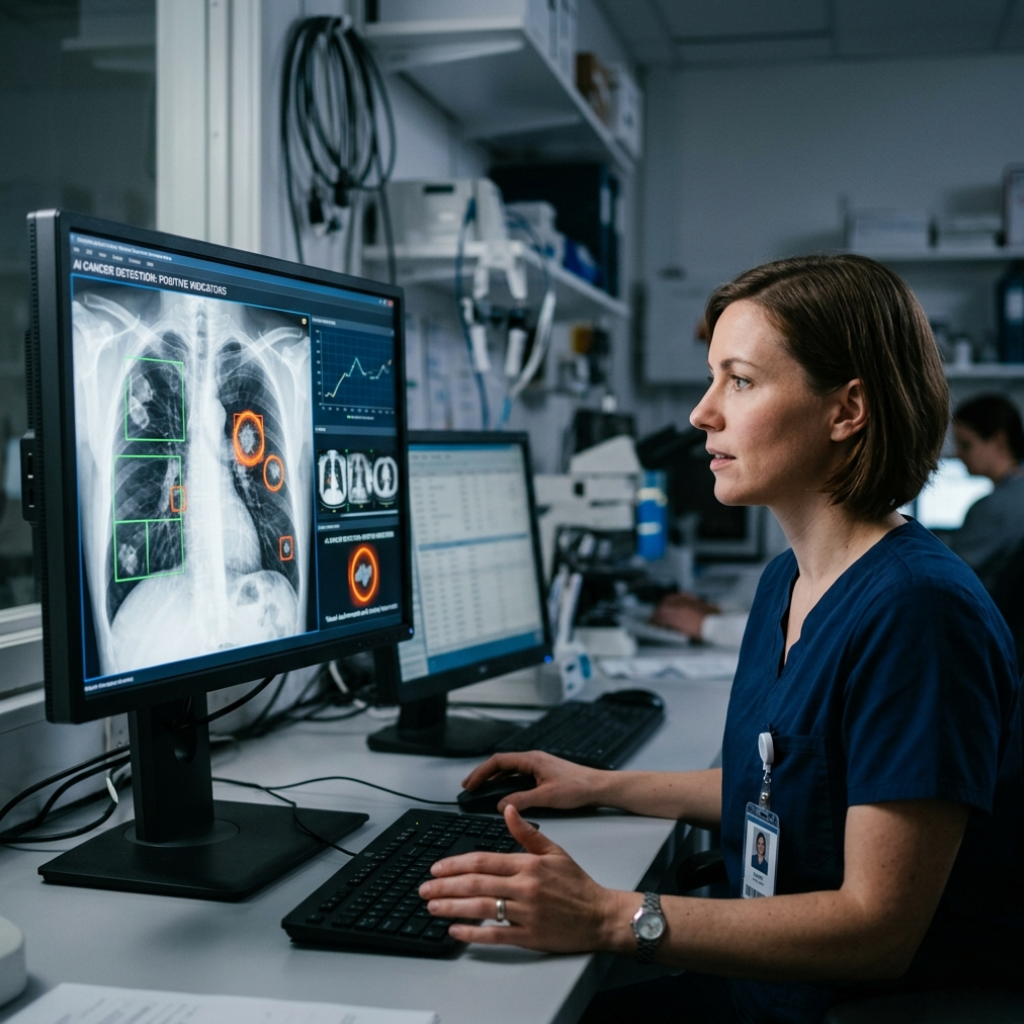
Artificial intelligence is gradually transforming modern medicine. Having proven its value in medical image analysis, treatment planning, and pharmaceutical research, it is now taking a new step forward in the field of screening.
A recent study published in the scientific journal *Nature Cancer* shows that the use of artificial intelligence systems in breast cancer screening could increase tumor detection by more than 10%, while significantly reducing the workload of healthcare professionals.
This research, conducted by scientists at the University of Aberdeen in collaboration with NHS Grampian and the technology company Kheiron Medical Technologies (now part of DeepHealth), provides concrete evidence of how AI can assist radiologists in the early detection of cancer.
AI at the Heart of Breast Cancer Screening
Breast cancer screening is a major public health issue. In the United Kingdom, women aged 50 to 70 are invited to undergo a mammogram every three years as part of the national screening program.
This system accounts for more than two million mammograms performed each year. Under the current procedure, each mammogram is typically reviewed by two different radiologists to reduce the risk of missing a tumor.
Despite this dual approach, certain types of cancer remain difficult to detect. Researchers estimate that about 20% of breast cancers may be missed during initial screening, particularly when abnormalities are not clearly visible on medical imaging.
It is precisely in this context that artificial intelligence can play a decisive role.
A large-scale study in a real-world screening program
The evaluation is based on the GEMINI project (Grampian’s Evaluation of Mia in an Innovative National Breast Screening Initiative), conducted within NHS Grampian in Scotland.
The researchers analyzed 10,889 mammograms performed as part of the national screening program, using artificial intelligence software called Mia, developed by the company Kheiron.
The goal was to assess how AI could be practically integrated into the clinical workflow—not to replace radiologists, but to serve as a decision-support tool.
The results are particularly significant:
- A 10.4% increase in cancer detections thanks to the integration of AI
- a reduction of more than 30% in radiologists' workload
- a reduction in the time it takes to announce results, from 14 days to approximately 3 days
These benefits are far from insignificant. In oncology, early detection is one of the most critical factors in improving the chances of recovery.
Improved detection of aggressive cancers
One of the most striking findings of the study concerns the types of cancers detected using AI.
Researchers found that artificial intelligence systems were able to identify more invasive and high-grade cancers—that is, potentially more aggressive forms of the disease.
By detecting these tumors earlier, AI could help:
- improve the chances of successful treatment
- slow the progression of the disease
- increase patient survival rates
In this context, AI does more than just increase the number of cancers detected; it improves the quality of medical screening.
Fewer unnecessary tests and less anxiety for patients
The study also highlights another significant benefit: the reduction in unnecessary follow-up tests.
In standard screening programs, many women are called back for further testing after an abnormal mammogram. However, in a large proportion of cases, these tests ultimately do not lead to a cancer diagnosis.
According to researchers, incorporating AI into the screening process could:
- reduce false positives
- reduce unnecessary biopsies
- reduce stress and anxiety for patients
For healthcare systems, this improvement also yields economic and organizational benefits by reducing the resources allocated to unnecessary tests.
AI as a second reader of medical images
In practice, the researchers tested 17 different scenarios for integrating AI into the screening process in order to identify the most effective configurations.
The approach that yielded the best results involves using AI as a second reader of mammograms, working alongside a human radiologist.
In this model:
- The radiologist performs the initial analysis
- The AI then analyzes the image to identify any anomalies
- The system can flag suspicious areas that require special attention
This approach combines human expertise with algorithmic analysis, while improving the overall performance of screening.
Addressing the challenges facing the healthcare system
The integration of artificial intelligence into cancer screening is also taking place against a backdrop of growing strain on healthcare systems.
Radiology faces several major challenges:
- an increase in the number of medical examinations
- a shortage of radiologists in many countries
- an aging population
- the increasing complexity of medical data
In this context, AI serves as a tool for enhancing medical capabilities, helping healthcare professionals analyze large volumes of medical images more quickly and efficiently.
The Ethical Issues Surrounding AI in Medical Diagnosis
Despite its promise, the use of artificial intelligence in medicine also raises a number of ethical and scientific questions.
First and foremost, AI systems must undergo rigorous clinical validation before being deployed on a large scale. Health authorities require solid evidence of their reliability, accuracy, and safety.
Furthermore, AI cannot replace medical judgment. It should be used as a decision-support tool, not as a substitute for the expertise of doctors.
Finally, algorithm transparency and the quality of training data remain key factors in ensuring the trust of healthcare professionals and patients.
Toward a new generation of augmented medicine
The results of this study offer a promising outlook for the future of cancer screening.
By improving early detection, reducing the workload of radiologists, and limiting unnecessary tests, artificial intelligence could help bring about a profound transformation in the practice of radiology and preventive medicine.
This development does not mean that technology is replacing doctors. On the contrary, it illustrates the emergence of augmented medicine, in which artificial intelligence enhances the analytical and diagnostic capabilities of healthcare professionals.
In the coming years, the challenge will be to successfully integrate these technologies into healthcare systems while ensuring their safety, transparency, and clinical utility.
If these conditions are met, artificial intelligence could become one of the most powerful tools for improving disease detection and saving lives.
Learn more
Advances in artificial intelligence in oncology are a broader illustration of how the healthcare sector is being transformed by advanced medical data analysis. On a related topic, check out our article “Your Health Explained by AI: OpenAI Breaks New Ground with ChatGPT Health”, which explores how AI systems are beginning to play an increasingly important role in medical support, symptom analysis, and access to health information.
References
1. De Vries, C. et al. (2026). Artificial intelligence in breast cancer screening: results from the GEMINI evaluation. Nature Cancer.
https://www.nature.com
2. National Institute for Health and Care Research. (2026). AI in Health and Care Award Programme.
https://www.nihr.ac.uk
3. University of Aberdeen. (2026). GEMINI Breast Screening AI Evaluation Project.
https://www.abdn.ac.uk