


Manifesto for Education Beyond Time
By Dr. Tawhid CHTIOUI, Founding President of aivancity School of AI & Data for Business & Society – France (www.aivancity.ai)
1. Introduction – The Day the Machine Entered the Classroom
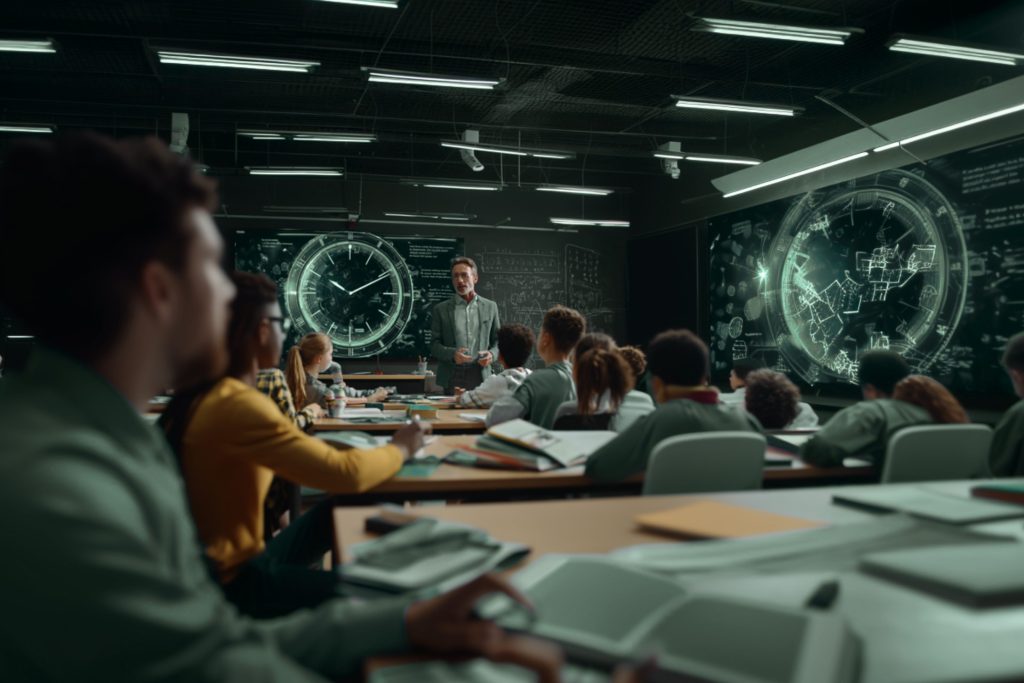
He walks into the classroom, just as he does every morning. But this morning, something is different. On his desk, his computer has already prepared the lesson plan, selected three videos tailored to the students’ level, automatically sent the attendance list to the administration, and, by analyzing interactions from yesterday’s classes, identified which students are most at risk of falling behind.
The screen lights up with a single sentence:“Here’s how your students are learning today.”
This is not science fiction. It is an ordinary morning in the year 2030, in an ordinary school, where the teacher now interacts with a system that learns faster than he does, yet feels nothing. A morning when pedagogy takes on a new dimension, when knowledge ceases to be a block to be transmitted and becomes a flow to be orchestrated. A morning when the teacher realizes that time is no longer the measure of his work, because everything accelerates, everything adapts, everything reinvents itself—except the system, which still insists on counting his contribution in hours.
For two centuries, education has moved to the beat of the clock: class periods, semesters, schedules, grading rubrics. But what becomes of a profession built on time when knowledge itself becomes instantaneous? When an algorithm can grade in seconds, adapt a lesson in real time, or suggest the best learning method for each student? Can we still measure teaching by duration, when the true value of learning lies in the transformation of a mind?
Artificial intelligence does not signal the end of teaching; it reveals its forgotten depth.
It breaks free from the hourly framework to restore to teaching what it had gradually lost: meaning, impact, and the lasting impression it leaves behind.
The teacher of the future may no longer have hours to fill, but a mission to fulfill: to inspire, to connect, to reveal, to elevate.
And perhaps, in this new world, the true measure of education will no longer be the time spent, but the knowledge imparted.
2. The Great Educational Shift
For centuries, schools were designed as places where knowledge was passed down gradually, in step with the seasons, the bells, and the school day. But recently, a silent earthquake has shattered this age-old rhythm: knowledge now evolves faster than it can be taught, and understanding renews itself faster than curricula can be written. We have entered an era where the pace of the world outstrips the rhythm of the school.
According to UNESCO, by 2024, more than 75% of countries had integrated or experimented with artificial intelligence tools within their education systems. In China, 100 million students use adaptive learning platforms like Squirrel AI every week, which continuously adjust lessons to each learner’s level.
In Europe, the European Commission has allocated €1.3 billion to the AI4Education program, designed to support the responsible integration of artificial intelligence in teaching. The Global Education Forum (2025) reports that 68% of teachers now use generative AI at least once a week to prepare their lessons.
And according to the OECD, 40% of schools in developed countries already rely on data analytics tools to track student progress.
These figures are not merely indicators of innovation; they signal a fundamental shift in our society. Education, long sheltered from technological upheaval, has now become a testing ground for algorithmic experimentation. The classroom is no longer a closed space but an ecosystem of dynamic data. Students are no longer passive recipients of knowledge but active creators of learning records. And teachers now work alongside systems capable of analyzing in a single night what once took a year to observe.
Slowly, schools are shifting from time to data, from fixed curricula to fluid knowledge. But this transformation is not just about tools or efficiency; it is about the very meaning of learning.
Once, we learned in order to remember. Now, we learn to understand, to interpret, to choose, in a world where everything is available, yet nothing is truly understood.
This transformation compels us to redefine the essence of teaching. For while machines can explain, repeat, and correct, only human presence can give shape to what data overlooks: intuition, attention, and trust.
That is where the invisible revolution takes place: teachers no longer impart certainties; they learn to navigate uncertainty. And perhaps this is the greatest shift of the 21st century: moving from an education based on memorization to an education based on discernment.
3. When Artificial Intelligence Becomes Part of Everyday Teaching Practice
Artificial intelligence has not swept into schools as a dramatic revolution, but rather as a quiet infiltration. It began on the periphery, in tools for grading, lesson planning, attendance tracking, and performance analytics. Then, little by little, it became a silent presence in the classroom—a mirror, an assistant, and sometimes even a partner.
- Learning at Your Own Pace
On an adaptive platform like Squirrel AI, a student with dyslexia sees their recurring mistakes identified, their learning pace adjusted, and instructions rephrased in real time. Elsewhere, platforms such as Century Tech offer each learner a personalized learning path based on their cognitive profile.
According to McKinsey (2024), students who use AI-driven personalized learning systems see their academic performance improve by an average of 30%. Knowledge is no longer linear; it becomes dynamic, responsive, and personalized. Each student progresses at their own pace, within a learning environment that feels more like a dialogue than a set curriculum.
- Rewriting Teaching Time
Just as students learn, artificial intelligence learns too—from their successes as well as from their mistakes. Tools like Gradescope or Copilot for Education can grade thousands of papers in a matter of hours, identify areas of misunderstanding, and generate personalized feedback.
Microsoft estimates that such systems reduce grading time by 45% while improving consistency.
At Stanford, an automated evaluation model analyzed 500,000 exams in under 24 hours. But the real transformation isn’t about speed; it lies in the redistribution of time. Teachers spend less time grading and more time guiding students. Time saved becomes time regained, and time regained becomes time for human interaction.
- Predicting Dropout Before It Leads to Absence
In Finland, the Learning Analytics 360 platform monitors students’ learning patterns on a daily basis: how often they log in, how regularly they complete assignments, and even the tone of their messages to teachers. When a warning sign appears—such as declining engagement or prolonged inactivity—the algorithm alerts the teaching team. Thanks to this system, Finland reduced its high school dropout rate by 18% in just three years.
This is no longer a school that reacts, but one that anticipates. A school that interprets data the way a doctor interprets vital signs: not to punish, but to care.
- Inventing New Forms of Pedagogical Creativity
Artificial intelligence is opening up an entirely new frontier in education: pedagogical co-creation. With tools such as ChatGPT Edu, a simple exercise can become an immersive simulation: the AI designs scenarios, adjusts difficulty levels, generates feedback, and reformulates questions based on students’ answers.
Other platforms, such as Perplexity Classroom or NotebookLM, enable teachers to create interactive debates, synthesize large sets of articles, or build customized learning materials in seconds.
These tools do not merely automate preparation; they extend the creative process of teaching. They offer educators a space for exploration and the freedom to test, refine, and reinvent without the constraints of time or format.
According to the Global Education Forum (2025), 70% of teachers now use generative AI to design or adapt their teaching materials. AI thus becomes a workshop for the imagination, a partner in design rather than a tool for production.
- Including Those the School Once Overlooked
In Spain, a refugee student can now attend classes thanks to an AI-powered translator that instantly interprets the teacher’s instructions.
In Norway, a visually impaired child learns to read with Seeing AI, an app that describes the pages aloud in real time.
UNICEF estimates that these technologies could make education accessible to 90% of children with disabilities by 2030.
Where the machine personalizes, it paradoxically re-humanizes: it restores a voice, a place, and an opportunity to those excluded by standardized systems. Quietly, artificial intelligence is reshaping the craft of teaching, lifting the burden of repetition, revealing hidden struggles, and enabling a pedagogy that is more precise, attentive, and humane. It does not replace the teacher’s intelligence; it amplifies it. It reminds us that knowledge is not imposed; it is woven. And perhaps true progress lies not in what the machine does for us, but in what it enables us to do once again: listening, understanding, and supporting.
4. The New Face of Teaching: From Transmitter to Architect of Meaning
For centuries, teaching meant speaking, conveying information, explaining, and helping others remember. But in a world where any student can ask ChatGPT a question just as easily as they would a living encyclopedia, the power of knowledge no longer lies in possession, but in interpretation.
Teachers are no longer the ones who hold the answers, but the ones who teach students how to ask better questions. Artificial intelligence does not eliminate the teaching profession; it transforms it. Where teachers once corrected, they now interpret. Where they once explained, they now guide. Where they once designed materials, they now create experiences. They become architects of meaning—people who weave together knowledge, emotion, and technology into a living, coherent whole.
According to the OECD (2025), 82% of European teachers believe their role will evolve toward more personalized and creative forms of teaching thanks to AI.
This is no coincidence. The machine takes on the burden of repetition; the human reclaims the privilege of building relationships. The teacher becomes a curator of content, filtering and contextualizing AI-generated resources to ensure relevance. They become a cognitive mentor, guiding students to interpret automated responses, to distinguish knowledge from information, and meaning from noise.
And above all, they become the conductor of educational intelligence, capable of orchestrating human and algorithmic contributions into a single symphony of learning.
Yet this transformation goes far beyond pedagogy. It challenges the very economic and cultural foundations of education itself. If teachers create value, why do we still measure it in hours?
In the era of generative AI, time is no longer the scarce resource; attention, impact, and emotion are. The model that charges by the hour belongs to an industrial past; the new paradigm that is emerging is an ecosystem of cognitive and human value.
One day, perhaps, teachers will no longer be paid based on the number of hours they teach, but rather for the transformation they bring about: for their students’ progress, engagement, creativity, and confidence.
Because teaching is not about simply passing the time; it’s about transforming it.
Education has always been an act of faith in the power of patience. But now, it is entering a new era—one in which time moves faster without losing its meaning, in which knowledge spreads more quickly than curricula, and in which a teacher’s worth is measured not by their schedule, but by the lasting impact they have on students’ minds.
Teachers are no longer mere implementers of programs; they are the poets of learning. They shape learning paths, forge invisible connections, and invent new languages between humans and machines. And in this quiet transformation, they may rediscover what they should never have lost: the freedom to view education not as a timed task, but as an art.
5. Teaching in the Age of Value: The End of Hourly Pay?
For generations, teaching has been measured in terms of time, hours of service, schedules, and teaching loads. Everything has been counted, planned, and calibrated.
Knowledge, however, no longer follows this logic. It moves at the speed of networks, updates in real time, and reinvents itself with every query. How can a profession built on slowness continue to define itself by the hour in an age of instant learning?
Time has long been the currency of education. We have rewarded presence, not impact; duration, not transformation. But in a world where AI can generate a full lecture, simulate a Socratic dialogue, or summarize an entire body of work in seconds, a teacher’s value no longer lies in what they do during their time, but in what they inspire beyond it. It is no longer about time spent; it is about the lasting impact.
Tomorrow, universities and schools may evaluate teaching differently—not by the number of hours, but by its educational value: the growth of students’ skills, their engagement, their creativity, and their renewed confidence.
Satisfaction rates may replace attendance hours; cognitive and emotional impact may replace administrative counts. The indicators of tomorrow will be measures of human transformation.
This shift may seem utopian, but it has already begun elsewhere. Some forward-thinking companies now reward employees not for the hours they work, but for the collective impact they make. Why, then, should schools—the birthplace of future professions—remain trapped in a model from the past?
By automating repetitive tasks, artificial intelligence frees teachers from the tyranny of the clock, inviting them to reclaim their true calling: to be agents of change.
The idea may sound provocative: what if we paid teachers not for ten hours of class, but for awakening ten minds? What if education stopped measuring teaching by duration and started measuring it by the value of the connection?
An inspiring hour can change a life; a hundred dull ones change nothing. The knowledge economy is no longer an economy of time; it is an economy of meaning.
This transformation calls for a new social contract in education—one built on trust, recognition, and legacy. Trust in pedagogical freedom. Recognition of the value created. And a legacy that lives on in the minds shaped by that experience.
Teaching should not be priced by the minute, but measured by the awakening of consciousness it generates. Because education has never been an industry of time. It is an economy of life—a delicate alchemy between speech, curiosity, and resonance.
And if the world of tomorrow ever truly measures a teacher’s impact, it will not count teaching hours, it will count the sparks they ignite.
6. The Teacher’s Future Skills: Between Code and Conscience
The 21st-century teacher is no longer merely an educator; they serve as a bridge between two forms of intelligence: that of machines and that of humans.
It is no longer enough to master a subject; one must understand the underlying logic, data architectures, the mechanics of machine learning, and the hidden biases of algorithms. But above all, teachers must learn to remain human in a world increasingly tempted to delegate thinking to systems.
According to UNESCO, by 2030, one in two teachers will need training in digital pedagogy and artificial intelligence. This requirement is not technical; it is philosophical. Because knowing how to use AI also means knowing what to entrust to it—and what must never be relinquished.
- Technical Skills: Understanding to Provide Guidance
The teacher of the future must be able to interpret a learning dashboard as intuitively as they now read a student’s paper. They must be able to interpret data, grasping not only what it reveals but also what it conceals.
They must use AI not to delegate teaching, but to deepen their understanding of learning rhythms, individual differences, and specific needs. Like a physician who listens as much as they observe, the teacher will have to combine algorithmic analysis with human intuition.
- Transversal Skills: Collaborating with Intelligence
Tomorrow’s classroom will no longer be a space for the transmission of knowledge but a space for collaborative learning between humans and machines. The teacher becomes a facilitator of collective creativity, guiding students not only with AI but through it. They must know how to orchestrate human-machine collaboration, cultivate curiosity, and foster critical thinking regarding automated responses.
The challenge is no longer to acquire knowledge more quickly, but to think more freely. Data becomes a medium for empowerment, but only when interpreted with discernment.
- Ethical Skills: Mastering Power, Preserving Meaning
In Europe, the AI Act classifies educational systems as “high-risk” applications. This means that the use of AI in education must comply with strict principles of transparency, fairness, and privacy protection.
Each teacher will thus become, in their own way, a guardian of educational integrity, ensuring data protection, understanding algorithmic logic, and defining the boundaries of automation. Yet beyond regulation, the challenge is moral: to remember that education is first and foremost an ethical act, and only then a cognitive process.
Because while machines can measure progress, only consciousness can measure meaning. And that may be the most urgent and precious skill of all: to hold together code and conscience, precision and responsibility, efficiency and empathy.
The school of the future will not simply train teachers to use AI. It will cultivate minds capable of using it wisely. And among them, teachers will lead the way—crafting meaning in a world of automation, exploring ways to reconcile calculation with compassion, and data with dignity.
7. Educational Equity: The Fragile Promise
Every technological promise has its downside. Artificial intelligence presents itself as a tool for equity, yet if misunderstood, mismanaged, or misallocated, it can become a catalyst for injustice.
For school has never been merely a place of learning; it is a place of balance, where every form of progress must be measured against the justice it serves.
Today, AI has the potential to bridge learning gaps. In India, AI Classrooms programs have increased math achievement rates by 25% in rural areas. In South Africa, the educational chatbot Rori Learn supports over 600,000 students via WhatsApp, providing personalized tutoring where no teachers are available. In France, AI-driven translation and speech tools help integrate students who speak other languages and those with visual impairments. These examples offer immense hope—the hope of a school system that is more just, more accessible, and more inclusive.
Yet behind these achievements lie deep, persistent divisions. Cultural and linguistic biases still permeate AI models, perpetuating the very inequalities they claim to address. The digital divide remains vast: 244 million children worldwide still lack stable internet access. And algorithmic opacity can obscure the decision-making processes that guide learning pathways.
Who owns this data? Who defines the value of success? Who ensures that AI tools foster freedom, rather than obedience?
Equity in education thus becomes a matter of governance. Artificial intelligence does not inherently make teaching fairer; it becomes fair through the way we design, train, and regulate it.
Educational AI deployed without conscience may widen divides; AI governed with wisdom can pave the way for a global cognitive democracy.
Education must therefore develop its own ethical framework for AI, one in which transparency is a core principle, where data belongs first and foremost to the people it describes, and where students are taught not only how to use AI but also how to question it.
To learn to think critically about technology is to learn to remain independent of it. True educational equality cannot be imposed through technology; it must be nurtured. It requires well-trained teachers, vigilant institutions, and enlightened policies. And it rests on a simple yet revolutionary idea: progress is not about automation, but about emancipation.
Artificial intelligence can homogenize or liberate, diminish or illuminate. Everything depends on how we view it. Perhaps the greatest challenge of the coming years will not be to equip every classroom with an intelligent assistant, but to make every mind more intelligent in the face of that assistant.
8. The Augmented School, Still Human
We are living through a pivotal moment in the history of education. For the first time, humanity shares its classrooms with a form of intelligence that never sleeps, never tires, never doubts.
It can answer, correct, translate, synthesize, but it knows nothing of what makes a lesson beautiful: the silence before an answer, the light in a student’s eyes when understanding dawns, the subtle vibration of connection.
That is where the boundary lies between artificial intelligence and human intelligence, in the capacity to give meaning to knowledge.
The school of tomorrow will be neither purely technological nor nostalgically traditional. It will be hybrid, profoundly human, and intelligently enhanced. Teachers will work alongside intelligent assistants capable of automating administrative tasks, adapting learning paths, and instantly suggesting educational resources. Generative AIs will design interactive exercises, simulate debates, and recreate scientific experiments. Data will allow for real-time adjustment of learning processes, detect difficulties, and support every learner at their own pace.
Yet none of this will ever replace the living presence of the teacher—the one who inspires, connects, reveals, and elevates.
For teaching in the age of AI is not about passing on what the machine already knows; it is about learning to think beyond it. It means giving students the ability to discern, to create, to question, and to imagine—all things no algorithm will ever truly be able to replicate.
The teacher’s role thus becomes that of a mediator of meaning, a guardian of critical thinking in an age of information overload, and a messenger of humanity in a world of computation.
To ensure that this educational revolution remains a human endeavor, three conditions are essential:
- Provide extensive training for teachers on the uses and limitations of AI, so they can use it as a tool for empowerment, not subjugation.
- Ensure the transparency and sovereignty of educational data, so that systems respect the cultural values and contexts of each society.
- Reaffirm the humanistic purpose of education: to learn not to produce, but to understand, to share, to invent, and to love.
Because, in the end, the true revolution does not lie in the machine that learns, but in the human being who relearns how to teach differently. AI reminds us that knowledge is alive, that it evolves at the speed of the world, and that teaching, at its core, remains an art form: an art of connection, of nuance, and of trust.
The school of the future will not be a data factory, but an ecosystem of meaning. A place where technology illuminates without overwhelming, where value is no longer measured by the number of teaching hours, but by the quality of the minds it inspires.
And perhaps then, the word “teacher” will regain its original meaning: not the one who speaks, but the one who helps others grow.
Manifesto of the Teachers of the Future
-
The future of education will no longer be measured in hours, but in moments of inspiration.
Teaching is not a matter of time; it is an inner process. -
A great teacher doesn't save time; they create it.
Time freed up by machines becomes time reclaimed for presence. -
Data can shed light, but only a gaze can truly teach.
AI may predict, but only consciousness can understand. -
To teach is not to fill minds, but to ignite them.
Knowledge is not a stockpile; it is a flame. -
AI can grade papers, but it cannot comfort a discouraged student.
Emotion remains the primary driver of learning. -
Knowledge is no longer transmitted; it is woven.
Every interaction becomes a thread in the fabric of collective meaning. -
You don’t measure the brightness of a lighthouse by how much energy it uses.
Likewise, you don’t measure a teacher by the number of hours they teach. -
Speed is worthless without direction.
AI accelerates everything, yet someone must still decide where to go. -
Teaching is not about adapting content, but about broadening perspectives.
Impact is measured not by what is seen, but by what remains unseen. -
And what if the true educational revolution began the day we stopped counting the hours?
On that day, school would cease to be a place of passage and become, once again, a place of transformation.
References
International Organizations
- UNESCO. (2024). Artificial Intelligence in Education: Challenges and Opportunities for Sustainable Development. Paris: UNESCO Publishing.
- UNESCO. (2023). Global Education Monitoring Report 2023 – Technology in Education: A Tool on Whose Terms? Paris: UNESCO.
- OECD. (2024). Education at a Glance 2024: OECD Indicators. Paris: OECD Publishing.
UNICEF. (2023). The State of the World’s Children 2023: For Every Child, Access to Education. New York: United Nations Children’s Fund.
Sectoral Studies and Reports
- McKinsey & Company. (2024). How artificial intelligence is transforming learning outcomes. McKinsey Global Education Practice.
Microsoft Education. (2024). The future of learning: AI tools and educator productivity. Redmond, WA: Microsoft Corporation. - Global Education Forum. (2025). Educators and Generative AI: The State of Adoption in 2025. Geneva: Global Education Forum Reports.
- Learning Analytics Research Network (LARN). (2024). Predictive Systems in Education: A Five-Year Impact Review. Helsinki: LARN Press.
International Programs and Initiatives
- European Commission. (2024). AI4Education program: Advancing responsible artificial intelligence in European schools. Brussels: Directorate-General for Education, Youth, Sport, and Culture.
- Squirrel AI Learning. (2024). Adaptive learning platforms for personalized education in China. Shanghai: Squirrel AI Research Division.
- Century Tech. (2024). The Future of Learning Analytics in UK Schools. London: Century Tech Education Report.
- Rori Learn. (2024). Scaling Mobile Learning for Equity in Sub-Saharan Africa. Cape Town: Rori Learn Initiative.
- AI Classrooms India Initiative. (2024). Education and Artificial Intelligence in Rural India. New Delhi: Ministry of Education & NITI Aayog.
Regulatory and Forward-Looking Frameworks
- European Parliament and Council of the European Union. (2024). Artificial Intelligence Act (AI Act): Regulation on Artificial Intelligence Systems. Brussels.
- OECD. (2025, forthcoming). Teachers for Tomorrow: Human–AI Collaboration in Education. Paris: OECD Future of Education Series.
Additional Sources
- Stanford University. (2024). AI-powered grading and large-scale assessment automation: A case study. Stanford Center for Educational Research.
- CNED – National Center for Distance Education. (2024). Pilot of an intelligent revision assistant in French high schools. Poitiers: CNED Innovation Lab.