


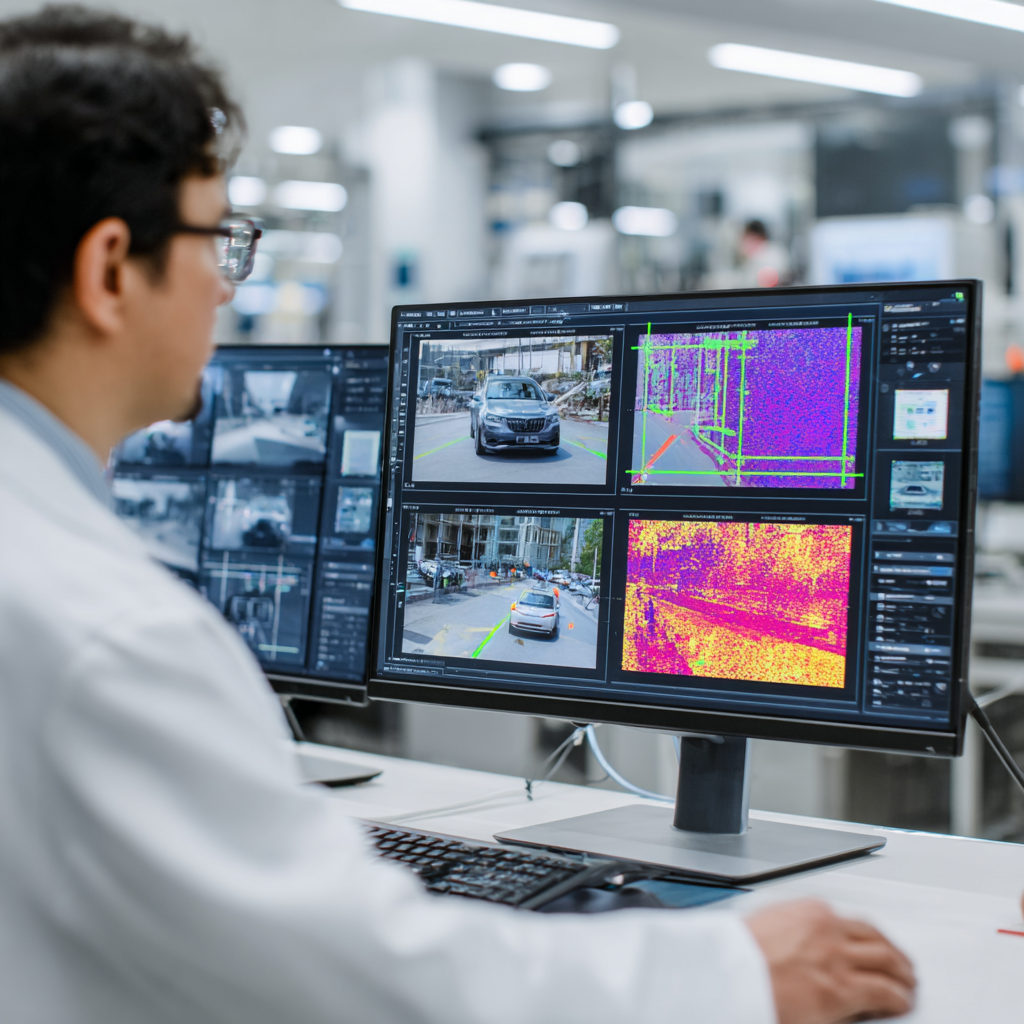
Computer vision is one of the most dynamic fields in artificial intelligence. Long reliant on manually annotated datasets, this discipline has undergone a major methodological shift in recent years: self-supervised learning, which enables models to learn how to structure visual information without direct human intervention.
In this context, Meta AI continues its groundwork on self-supervision with the launch of DINOv3, a new generation of image analysis models based on large-scale self-learned representations. As the successor to DINOv1 and v2, DINOv3 features an architecture optimized to accurately and robustly capture the structure of complex images, while maintaining a zero-shot approach without the need for extensive fine-tuning.
This model is part of Meta’s broader strategy to build a general-purpose, robust, and supervision-efficient visual AI. But beyond its technical performance, DINOv3 also raises questions about the governance of these powerful models and their potential use in sensitive areas.
Self-supervision: When AI Learns to See on Its Own
Self-supervised learning (SSL) involves creating training tasks directly from the data itself, enabling models to discover internal patterns. In computer vision, this means that the model learns to recognize an image’s structure, its objects, and the relationships between them, without relying on explicit labels.
Compared to traditional supervised learning (which requires millions of manually annotated images), SSL offers several advantages: scalability, reduced reliance on human input, cross-domain generalization, and better adaptation to unknown environments.
Meta has established itself as one of the pioneers of this visual approach, with its DINO (Distillation with no labels) models, which use a distillation mechanism between two branches of the same model to learn discriminative representations. DINOv3 represents the culmination of this line of research to date.
What DINOv3 offers in addition
DINOv3 introduces several significant architectural and methodological advancements:
- It is based on a Vision Transformer (ViT) architecture, which is designed to process images as sequences of patches.
- It uses a multi-crop, multi-scale strategy, which allows the model to learn spatial relationships at different levels of granularity.
- It is trained on a very large scale using diverse unlabeled datasets (ImageNet, LAION, etc.), which enhances its ability to extract stable visual invariants1.
On standard benchmarks (ImageNet-1k, COCO, ADE20K), DINOv3 achieves scores comparable to, or even higher than, those obtained by large-scale supervised models such as ResNet-152 or ConvNeXt, while maintaining greater versatility (dense segmentation, object detection, transfer to other domains)2.
Use Cases: From Segmentation to Industry
DINOv3 can be used in a variety of settings, including:
- Semantic segmentation: precise identification of regions of interest in an image (objects, textures, structures).
- Machine vision: defect inspection without the need for pre-labeled data.
- Autonomous robotics: real-time environmental perception, with generalization to unknown scenes.
- Medicine: Extraction of complex visual features from sparsely annotated medical images.
- Preparation for multimodal systems: can be combined with text or audio models for integrated systems.
DINOv3 stands out for its ability to serve as a general-purpose backbone in a more complex processing chain, particularly in architectures such as " segment anything " or multimodal assistant systems.
Ethical Issues: Visual Power That Needs to Be Managed
While self-supervision reduces reliance on annotated data, it does not eliminate ethical risks. Several issues arise:
- Implicit biases: Images from the web, even if they are not labeled, contain stereotypes (cultural, social, geographical) that the model can learn and amplify.
- Opacity: The representations learned by DINOv3 are difficult to interpret, making it challenging to identify errors or internal biases.
- Use in surveillance: These models can be integrated into video surveillance, behavioral monitoring, or consent-free recognition systems.
- Industrial misuse: without proper oversight, DINOv3 could be used to automate intrusive commercial or political practices in unregulated contexts3.
It is therefore essential to document these models, encourage independent audits, and establish standards for responsible deployment, particularly with regard to the protection of fundamental rights.
A step toward general visual AI?
DINOv3 is not a finished product, but a foundational building block in a broader vision of universal visual AI, capable of adapting, learning, and generalizing without supervision. Meta is already exploring integrations with its multimodal projects (such as I-JEPA or ImageBind) and interactive assistants that combine vision, text, and sound.
The widespread adoption of this type of model could accelerate positive applications in science, healthcare, and education, provided that ethical and technical safeguards are put in place as it becomes more widely used. Ultimately, DINOv3 could help foster a more restrained, open, and transparent ecosystem for visual AI.
Learn more
To continue exploring advanced visual AI, check out the article OpenAI and the Visual Intelligence Revolution: Artificial Intelligence That “Sees and Thinks” on our blog. This article analyzes OpenAI’s new multimodal approaches, capable of combining vision and cognition, and offers additional insight into the evolution of AI vision.
References
1. Caron, M. et al. (2023). Emerging Properties in Self-Supervised Vision Transformers. Meta AI Research.
https://arxiv.org/abs/2304.08465
2. Meta AI. (2025). Introducing DINOv3: High-Performance Self-Supervised Vision.
https://ai.meta.com/blog/dinov3
3. European Commission. (2024). Ethical AI Guidelines for Computer Vision.
https://digital-strategy.ec.europa.eu/