


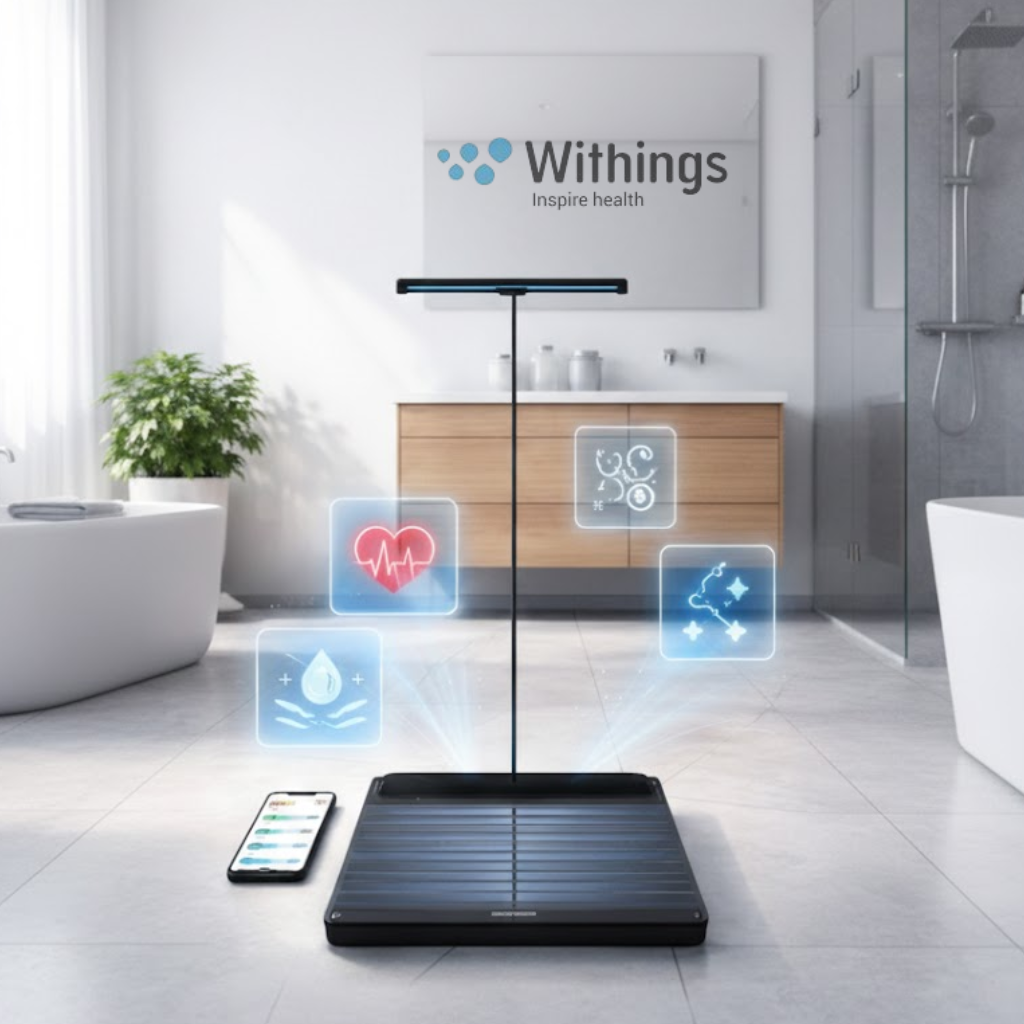
Seventeen years after launching one of the first smart scales on the market, Withings is taking things to the next level. Unveiled at CES 2026 in Las Vegas, the Body Scan 2 is no longer designed simply as a weight-tracking device, but as a true wellness hub capable of analyzing 60 health metrics in just over a minute. The company’s clear ambition is to transform a daily routine into a tool for the early detection of subtle signs of chronic diseases.
From a smart scale to a home health hub
The Body Scan 2 is the successor to the original Body Scan, launched in 2022, which was already a pioneer thanks to its integration of an ECG and advanced body composition analysis. This new version takes things a step further. Withings no longer merely aggregates data but advocates a holistic approach to health, centered on cardiovascular, metabolic, cellular, and neurological aspects. After each measurement, the user receives a detailed health report, designed to be interpreted over time rather than as a single snapshot.
This approach is part of a well-defined public health context. According to the World Health Organization, chronic noncommunicable diseases now account for nearly 74% of deaths worldwide1, and often develop silently over many years.
Sixty biomarkers for detecting weak signals
Withings states that the Body Scan 2 is capable of measuring approximately 60 biomarkers, organized around several key physiological categories. The heart takes center stage, with a six-lead ECG paired with cardiac impedance measurement (CIM) to assess cardiac pumping capacity. Arteries are also analyzed using pulse wave velocity, a recognized indicator of cardiovascular risk and hypertension.

The scale also assesses metabolic and cellular health by analyzing intracellular hydration, cell membrane integrity, and a glycemic regulation score. Finally, a nervous system health score—measured via skin conductance in the feet—helps evaluate certain peripheral dysfunctions often associated with diabetes or aging2.
Advanced technology in 90 seconds
Technically, Body Scan 2 uses ultra-high-frequency bioimpedance spectroscopy (BIS), a method that analyzes body tissues at various levels, including the intracellular level. The entire measurement takes about 90 seconds—longer than a standard weigh-in, but significantly shorter than most equivalent clinical tests. The user must hold a bar equipped with a screen, which sends low electrical currents through the entire body to collect data.
The scientific literature shows that BIS can provide relevant information on cellular hydration and certain metabolic abnormalities, particularly those related to insulin resistance3.
A commitment clearly focused on prevention
Withings positions Body Scan 2 as a tool for active prevention. The goal is not to provide a medical diagnosis, but to identify trends and potential deviations before symptoms appear. This approach is particularly relevant for silent conditions such as hypertension or type 2 diabetes. The latter currently affects more than 530 million adults worldwide, a significant proportion of whom remain undiagnosed4.
In this context, Body Scan 2 is aimed less at the general public who use it occasionally and more at serious athletes, older adults focused on longevity, or people who engage in regular health monitoring, sometimes in consultation with a healthcare professional.
A clear commitment to a premium positioning
Withings has announced that the product will go on sale in 2026, priced at €499.95. This high price point clearly positions the Body Scan 2 in the high-end segment of the connected health market. In return, the company promises a battery life of approximately 15 months on a rechargeable battery, a key factor in ensuring hassle-free daily use.
As is often the case with medical devices, the timeline remains contingent on obtaining the necessary regulatory approvals, including the CE mark in Europe and, where applicable, FDA approval in the United States5.
Ethical issues and limitations: between prevention and overinterpretation
Body Scan 2’s ability to collect 60 biomarkers inevitably raises the question of where the line lies between useful prevention and body surveillance. Access to such a wealth of data can foster healthy awareness, but also carries the risk of overinterpretation by users without medical supervision. Normal physiological variations may be perceived as alarming signals, leading to anxiety or inappropriate decisions.
The issue of accountability is also central. Although Withings emphasizes that Body Scan 2 does not provide any diagnoses, the level of detail in the reports can influence behavior. The challenge therefore lies in the clarity of the messages, the educational value of the visualizations, and the tool’s ability to highlight its own limitations. Finally, the management of health data—including its storage, retention period, and potential sharing—are key factors in building trust. As connected devices become more precise and intrusive, the social acceptability of these technologies will depend as much on their usefulness as on the transparency of the companies that design them.
A European vision for connected health
With Body Scan 2, Withings is cementing its unique path in health tech. While some companies focus on approaches centered on well-being or performance, the French firm champions a more medical vision, rooted in prevention and long-term monitoring. By transforming the scale into a longevity station, Withings envisions a future where the bathroom becomes a regular health monitoring hub, and where data—when properly interpreted—can contribute to a more preventive, personalized, and accessible form of medicine.
Learn more
Gemini’s evolution toward more context-aware intelligence is part of a broader transformation of search and assistance tools. In the same vein, check out our article “Google Search’s AI mode expands to 180 countries: a new era of search”, which analyzes how Google is integrating generative AI into the core of its services to offer increasingly personalized and proactive experiences.
References
1. World Health Organization. (2023). Noncommunicable diseases.
https://www.who.int
2. Tesfaye, S. et al. (2010). Diabetic neuropathies. The Lancet. https://doi.org/10.1016/S0140-6736(09)61962-6
3. Kyle, U. et al. (2004). Bioelectrical impedance analysis. Clinical Nutrition.
https://doi.org/10.1016/j.clnu.2004.04.002
4. International Diabetes Federation. (2023). IDF Diabetes Atlas.
https://diabetesatlas.org
5. European Commission. (2021). Medical Device Regulation (MDR).
https://health.ec.europa.eu