



In less than three years, generative artificial intelligence has reached a major milestone in France. Long viewed as an innovation reserved for experts or large tech companies, it has now become part of daily life for a large segment of the population. Whether searching for information, rewriting a text, preparing a presentation, translating a document, or generating ideas, these digital tasks are now carried out through conversational interfaces.
The 2026 Digital Barometer, conducted by Crédoc on behalf of Arcep, Arcom, CGE, and ANCT among 3,544 people representative of the French population (survey conducted from June 5 to 21, 2025), confirms the scale of this transformation1. The figure speaks for itself: 48% of French people say they use generative AI. In other words, nearly one in two citizens is already interacting with a language model.
Faster adoption than the Internet
In 2023, only 20% of French people were using generative AI. Two years later, that figure had risen by 28 percentage points. This acceleration is remarkable. By way of comparison, it took the internet nearly five years to reach a similar level of penetration among the French population.
To illustrate the extent of this growth and how usage is distributed across age groups, the official infographic for the 2026 Barometer summarizes the key indicators:

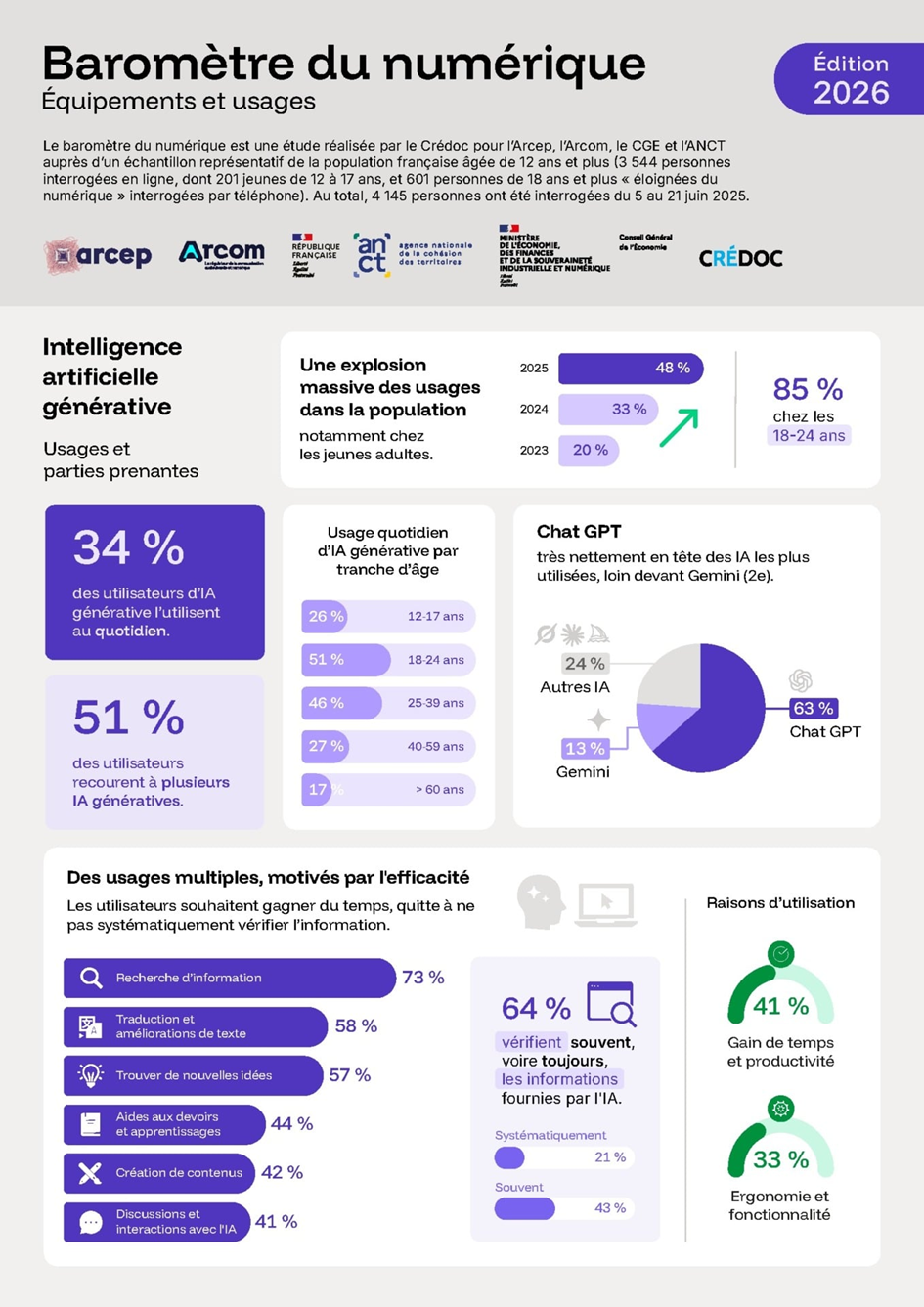
© Crédoc for Arcep, Arcom, CGE, and ANCT (2026 edition)
In particular, adoption is especially high among 18- to 24-year-olds (85%), and ChatGPT clearly dominates the market (accounting for 63% of usage), confirming that the market is concentrated among a few major players.
AI benefits from an unprecedented snowball effect: initially free services, integration into existing tools, virality on social media, and constant media coverage. The technology hasn’t required heavy infrastructure or specialized equipment. A simple smartphone is all that’s needed.
Generational differences remain pronounced. The 18–24 age group has an 85% usage rate, while managers and professionals have a rate of 78%1. AI is thus becoming a strategic tool for academic and professional optimization.
AI as a New Way of Thinking About Information
The primary reported use is for information retrieval: 73% of users rely on AI to get quick answers1. The tool tends to partially replace traditional search engines by providing a direct summary rather than a list of results.
Writing assistance and translation come in second place, followed by idea generation. This ranking shows that AI is not limited to providing access to knowledge; it is becoming a tool for intellectual production.
This shift is significant. Users no longer simply consult sources; they interact with an interface that rephrases, structures, and contextualizes the information.
A measured level of trust and a critical mindset
Widespread adoption does not mean blind acceptance. The Barometer reveals that 64% of users verify the responses generated by AI1. Even among those who say they trust it, 62% continue to verify the information.
This caution is consistent with the scientific literature. Language models can generate factual errors or approximations, a phenomenon that has been extensively documented2. The platforms themselves remind users that responses must be verified.
AI thus appears to be a cognitive assistant, but not yet an indisputable source.
A market that is still largely free
While usage is becoming more widespread, the business model remains hybrid. Only 19% of users—or about 9% of the total population—report paying for a premium subscription1.
The groups most likely to subscribe are working professionals, recent graduates, executives, and high-income households. This finding raises a strategic question: Will access to advanced versions of these models become a competitive advantage reserved for certain groups?
As AI enhances productivity, creativity, and analytical capabilities, unequal access to the most powerful tools could widen socio-professional disparities.
Ethical Issues: Between Dependence and Cognitive Disconnect
The widespread adoption of AI raises questions about our relationship with knowledge. When nearly one in two French people uses an algorithmic interface to access information or create content, access to knowledge is filtered through a single synthesis.
First challenge: cognitive dependence. If AI becomes the primary gateway to information, the diversity of sources may diminish3.
Second challenge: bias. Models learn from massive datasets that reflect existing cultural and social imbalances. Despite corrective measures, these biases never completely disappear3.
Third challenge: the cognitive divide. Young urban professionals are embracing AI in droves, while other groups are lagging behind. The inequality is no longer merely technological, but also intellectual and professional.
In this context, the European AI Act adopted in 2024 regulates high-risk systems and requires greater transparency4. But regulation alone will not be enough. Education in digital literacy is becoming a central issue.
A cultural shift that is already underway
The 2026 Barometer does not merely show a statistical increase. It reveals a shift toward normalization. AI is no longer a gimmick or a futuristic promise. It is a tool that has become part of everyday practice.
With 48% of users, France is entering a phase of technological maturity where the focus is no longer on adoption, but on impact—impact on productivity, learning, content creation, and the organization of work.
The challenges of the coming years will not be purely technical. They will be strategic, social, and educational. Artificial intelligence is now a cornerstone of France’s digital ecosystem.
Learn more
The widespread adoption of AI by the general public is part of a broader transformation of everyday digital practices. On a related topic, check out our article “We Live with AI as a New Habit: A Look Back at a Pivotal Year”, which analyzes how artificial intelligence has gradually become integrated into personal and professional routines, to the point of becoming an almost invisible yet foundational tool.
References
1. Crédoc. (2026). Digital Barometer 2026. Arcep, Arcom, CGE, ANCT. Digital Barometer – 2026 Edition | Arcom.
https://www.arcom.fr
2. Ji, Z. et al. (2023). Survey of Hallucination in Large Language Models. ACM Computing Surveys.
https://arxiv.org
3. Bender, E. et al. (2021). On the Dangers of Stochastic Parrots. FAccT.
https://dl.acm.org
4. European Parliament. (2024). Artificial Intelligence Act.
https://eur-lex.europa.eu